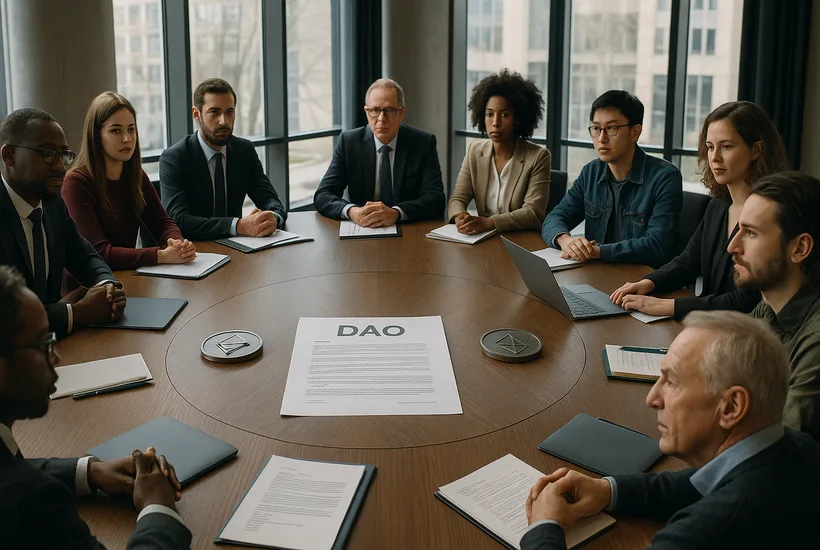

Decentralized Autonomous Organizations (DAOs) make for quite an interesting part of the Web3 ecosystem. They bring a new organizational model to light that testifies that the distribution of power and governance can help DeFi protocols grow with community. In simpler words, a DAO can be explained as a club or a community, that is governed via smart contracts and consensus — rather than a single controlling entity.
DAOs can exist across a wide range of categories — including protocols, investments, grants, social networking, and media among others. Across these categories, DAOs give members the right to vote on proposals to finalize decisions. DAO members can also collaborate on work and distribute rewards transparently — all of which adds to the strength of its ecosystem.
With UniSwap, Aave, and MakerDAO being the top three DAOs by market cap, over 13,000 DAOs now make for the sector’s global ecosystem. As per CoinLaw estimates shared in August, the collective treasury of the DAO ecosystem stands at around $24.5 billion with over 11 million participants in the sector.

Steps to enter a DAO
As more DAOs enter the market, it could be overwhelming to understand the structured approach to exploring them. Here, we understand the steps that beginners could take to enter and explore the sector.
- Understand the working of DAOs: As explained above, DAOs are not governed by a single entity, buy by the members of its community. Because DAOs are blockchain-based, they are transparent — as in all the transactions and votes are permanently registered on a public ledger. Members of each DAO generally hold a native governance token, that are key to using their voting rights. The more tokens one holds, the more weight their vote carries, Investopedia had highlighted in a recent article.
- Identifying interests: DeFi DAOs work around loan management, financial services, and crypto exchanges among others. Categories like social DAOs and gaming DAOs, on the other hand, are build around shared interests and social causes. The vast fabric of DAOs could get one confused and lost — hence, it is of umpteenth importance that find DAOs that align with the joiners’ interests.
- Scanning DAO aggregators: Platforms like DeepDAO, DAO Central, DAO Wow, and Messari’s DAO dashboard provide lists of DAOs that can be scanned by those interested in exploring the sector. Details like active proposals, treasury data, and governance structures related to the listed DAOs can be checked through these aggregators.
- Testing the waters: One can explore a DAO without being exposed to a financial risk by going on-chain and reading through past and current proposals on its governance portal. Joining the public communication channels and sub groups of the DAO can allow one to add a new non-binding proposal for community feedback.
- Wallet creation: If one decides to start financial participation in a DAO, the requirement to acquire a governance token would become crucial. Hence, a crypto wallet on platforms like the MetaMask needs to be created to hold the governance tokens of one’s DAO of choice.
- Start Voting: Each wallet needs to be connected to the governance portal of a DAO for members to be able to cast their votes on circulating proposals.
Understanding through example
The Uniswap DAO, as per CoinMarketCap, holds $5.9 billion in market cap. UNI serves as the governance tokens for the Uniswap ecosystem.
Falling under the protocol category, Uniswap operates as a decentralized exchange supported in the Ethereum blockchain via smart contracts.
Members of the Uniswap ecosystem can propose the additions of new tokens, removal of old ones, or pitch changes to the security of the protocol for voters to agree or disagree on. Before a formal vote, proposals are usually discussed on the Uniswap governance forum to gather community feedback.
Risks involved
Bias, negligence, and fraud are among risks plaguing the DAO sector. Notorious actors can exploit the community element of DAO governance to defraud others. Purchasing governance tokens of any DAO is simple — and since more tokens give more vote weightage, manipulators could easily purchase tokens in bulk and change the trajectory of decision-making.
Also, because DAOs rely heavily on smart contracts — coding loopholes or vulnerabilities can often pose cyber risks to these ecosystems among other issues.
An article by Dac Beachcroft highlighted that DAOs, for now, are not fully recognizable in terms of legal attributes. The London-based international law firm noted that individuals must take a researched and thoughtful approach towards DAOs as regulatory, governance, and legal parameters around Web3 continue to evolve on a global level.