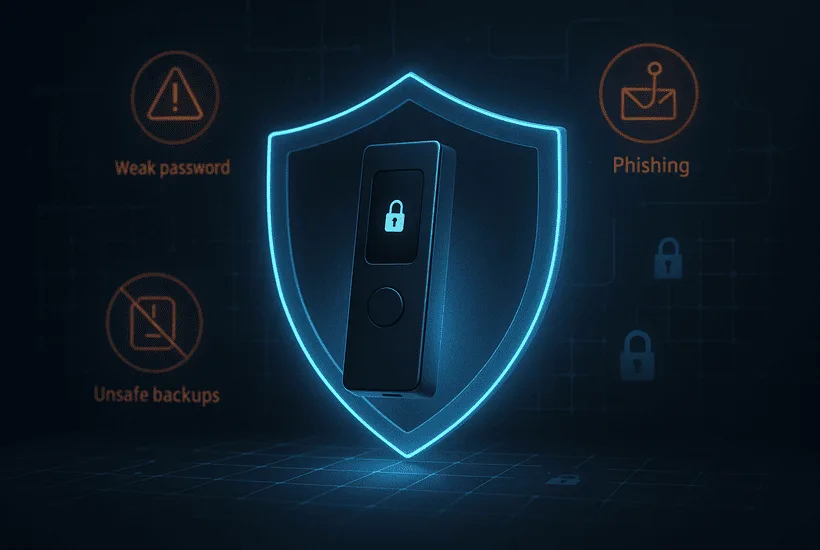



The centralized crypto exchanges, over the last few years, have witnessed a bunch of hacks leading to the loss billions in crypto funds. Centralized exchanges like Binance, Coinbase, and Kraken among others, hold the private keys to the crypto assets that the users store on the platforms. The web connectivity of these private wallets puts them at major risks of being exploited.
Security analysts from the crypto space have often advised asset holders to save their holdings in hardware wallets. These wallets are not connected to the internet which categorizes them as cold wallets.
Hardware crypto wallets are electronic devices that may look like pen drives, credit cards, or even compact hard disks. They are designed to store the private keys of users’ crypto assets safeguarded against threats like malware and hacking. Trezor, Ledger, and Tengem are among companies that offer hardware crypto wallets.

Through this article, lets explore how crypto holders can step into the hardware wallet ecosystem while keeping in mind the best practices and common mistakes.
Entering the ecosystem
Purchasing a wallet device: The market offers a range of hardware wallets that fall within the average price range of $50 to over $500. Buyers are strongly advised to analyze the security records, market reputations, reviews, and comparisons of these brands before investing in the device. While some hardware wallets provide support for all cryptocurrencies, the others may come with support for only select altcoins. So, buyers must ensure that the wallet they’re looking to buy have support for the assets they plan to store.
Buy new, buy direct: It is of umpteenth importance that buyers must invest in new hardware wallets only as pre-owned devices could be malware-infected or corrupted. Purchasing from the manufacturer’s official website or an authorized, verified retailer is strongly recommended.
Understanding companion software: A majority of hardware wallets come with apps to manage settings and view stored information. These applications must only be downloaded from the websites of manufacturers. No third-party app must be engaged with. Once the related app is downloaded and installed, users will need to plug in their wallets into the computer using the cable that comes with the wallet device. The app will then prompt users on how to set up the wallet.
Setting up PIN: The PIN number will likely be the first layer of security for the hardware wallet. It could be set either through the app or through physical keys on the wallet device. It is advisable to keep this PIN longer than four digits and different from obvious choices like birthdays or sequential numbers. Most wallets can wipe itself off or get temporarily locked after logging multiple incorrect pin punch-ins.
Generating seed phrase: The seed phrase is the most crucial element of a hardware wallet. It can essentially be explained as the master key to the wallet device. Once the aforementioned steps are completed, the wallet will generate the seed phrase. This sentence could be as long as 12 or 24 words. It is displayed on the isolated screen of the wallet device itself, and not on the app. Once this phrase is generated, it must be accurately hand-written onto a paper. The wallet could ask users to enter a few words from the seed phrase to re-verify the accuracy.
Initiate test transaction: Using the companion software app, users must initiate a small test transaction. The app will be able to generate a “receiving address” for this test transaction without needing anybody else.
Transfer funds from hot wallets to hardware devices: Once the tests are completed, the assets stored in centralized exchanges can be withdrawn and wired into personal hardware wallets.
Best practices and common mistakes
The seed phrase must not be saved as a picture on the phone memory or on cloud. The physical paper copy must be stored safely in a private safe, that is not accessible to all. The safe should also not be typed into a messaging app for quick access.
Nobody from the wallet manufacturers are likely to ask for details like PINs or seed phrases for anything. In case somebody does, it should immediately raise a red flag as they could be hackers or scammers.
While these wallets are safer alternatives to web-connected hot wallets, they are at risks of physical vulnerabilities, human errors, and advanced social engineering attacks.
In case the physical device is lost or damaged, a new one can be purchased and used to access stored crypto funds with the previous wallet’s seed phrase.
If the seed phrase, however, is lost — asset holders would risk losing complete access to their funds. No recovery service is established by any manufacturer to help extract these funds back.