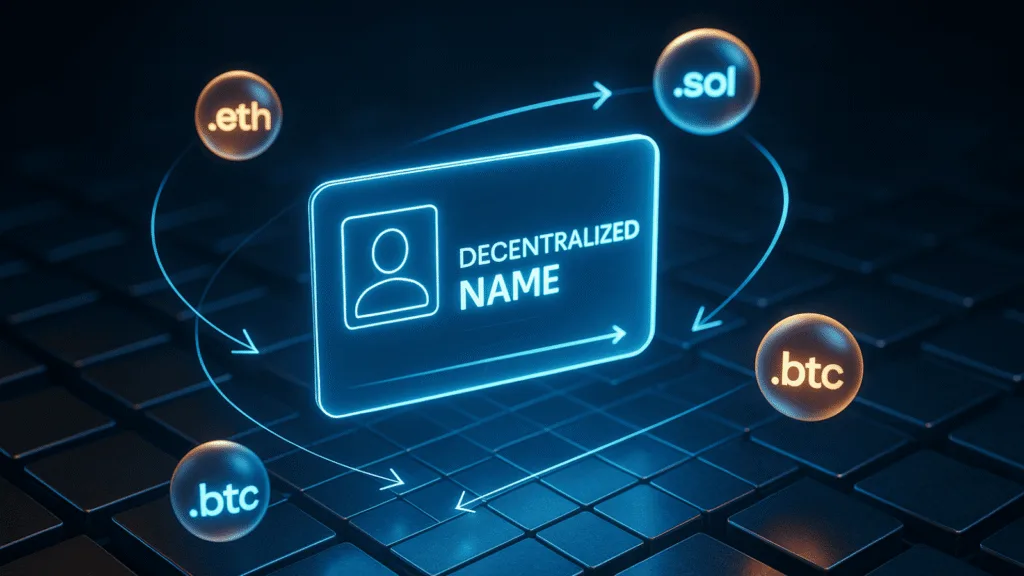



Remember when around the mid-1990s, securing a customized “.com” domain felt nothing less than a celebratory accomplishment? Now, the domain phenomenon is returning – this time on the blockchains with names ending in “.eth”, “.sol”, and “.crypto” among others. In the Web3 arena, these fall under the category of decentralized identity domains.
Understanding decentralized names
Decentralized names can be explained as blockchain-based identifiers that act like web domains or usernames but are stored on-chain. This lets the domain holders own and control their Web3 names directly through the private keys of their crypto wallets, eliminating the involvement of central registrars.
Because these names are stored on blockchains and not on centralized servers, governments or platforms cannot easily suspend or censor the sites or identities of Web3 domain name holders.

The concept popularized after ENS Labs launched the Ethereum Name Service (ENS) with .eth domains in 2017. Later, other blockchain players like Polygon and Solana also launched similar offerings with domains ending with .polygon and .sol.
The most prominent use case for these domain names is that they can replace complex, alpha-numeric crypto wallet and on-chain identities with simple one word names.
Five steps to claim your Web3 domain names
Choosing a name service: At present, multiple Web3 platforms are offering decentralized domain names. Alongside ENS, Polygon, and Solana – a platform dubbed Unstoppable Domains bring multi-chain domain names. While choosing a name service, users must check which blockchain ecosystem they interact with the most. Unstoppable Labs also offers .crypto or .nft domains to enable engagements with multiple wallets.
Linking wallets: Users will need to connect their crypto wallets to their choice of the domain name service. The wallet addresses essentially act like login credentials to enter the name service. Integrating the wallet in this step also comes-in handy to pay the fee for users acquiring their desired Web3 names. Wallet platforms like MetaMask or Phantom among others are compatible with these name services. Potential buyers who do not have a wallet will be prompted to create one by the name service platforms. These wallets must be funded with the native crypto of the domain’s blockchain for fee transactions.
Picking a name: Here comes the fun part where users are needed to customize their Web3 names like – “username.eth” for instance. If the choice of name is not available, some services let buyers place bids to acquire the names of their preference from current holders.
Confirming name purchase: Different name platforms have different purchase policies. For a .eth domain name, ENS requires buyers to lock-in a period of one year or more to use the name and renew it later for a fee. While Unstoppable Domains allow one-time name purchase with no renewal charges, Solana asks for a pocket-friendly purchase fee in the SOL token. Platforms generally charge a registration fee and a network gas fee to complete a domain sale.
Confirmation and use: In this final step, users will re-set their crypto wallet addresses and confirm their acquired Web3 domains as their authenticated identities. Once this step is completed, domain holders will be able to carry crypto transactions using a simple name instead of long and complicated wallet addresses. These domains cal also let holders host decentralized websites and use it as their IDs across decentralized apps.
Once owned, users can later transfer or sell their domains on NFT marketplaces such as OpenSea and Magic Eden or put them up for bids on platforms like Handshake.
Heeding caution
When registering a decentralized domain, buyers must check, confirm, and only engage with official sites, dodging the several fake clone sites.
Before registering for names, users must thoroughly check and understand the gas price charges they are likely to incur. This will prepare them with the required crypto tokens loaded into the connected wallets.
It is noteworthy that these Web3 domain names are not yet very compatible with standard browsers for now. They are still hardly in competition with traditional domain name systems like .com and .org, keeping their adoption and uses comparatively limited for now.
Additionally, setting up decentralized domains require entering the crypto wallet ecosystem, paying gas fees, and managing private keys with the risk of permanent loss of ownership if linked wallets and private keys are accidentally lost.