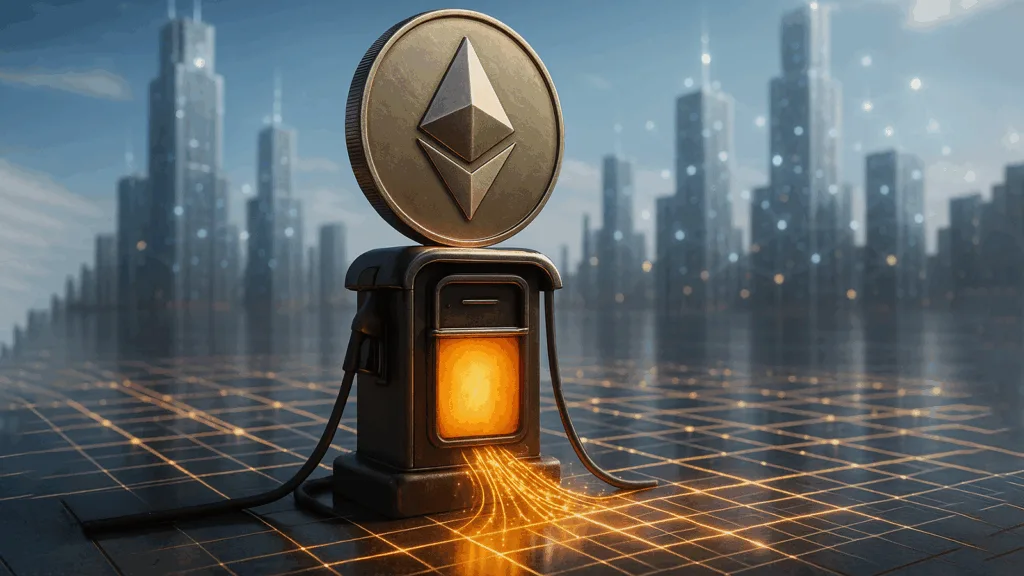



The cryptocurrency world is no longer just coins and tokens; you have decentralized apps, smart contracts, digital assets like NFTs, and a lot more. Now, have you ever tried to send ETH or mint a non-fungible token? If yes, then you may have encountered the phrase “gas fees”. Well, it has nothing to do with your car or utility bill. But consider it as the equivalent of tolls necessary to move transactions on the Ethereum network. Just think of it as the fuel that keeps the blockchain engine running.
What is a gas fee, and why does it exist?
Simply put, a gas fee is the payment you make to have your transaction processed and recorded on the Ethereum blockchain. Here, Ethereum is not just the coin, it is a network or a global computer where anyone can run code, execute contracts, or transfer assets. That means every action will require computational work from the network’s validators. Whether it’s sending ETH to a friend, swapping tokens on a decentralized exchange like Uniswap, or voting in a DAO, all this would require a validator, ever since Ethereum switched to Proof-of-Stake in 2022.
Gas fee, then serves two main purposes: it prevents spam and incentivizes participation. Without fees, nefarious minds would spam the network with junk transactions, which could bring the network to a halt. Fees ensure only serious users proceed with their transactions. In return, validators are rewarded for securing the network by verifying and adding transactions to blocks.

How is gas fee calculated?
Gas fees aren’t one flat rate for all. They’re dynamic and calculated based on the complexity of your transaction. To calculate gas fees, you must know basic concepts like a gas unit and gas price, gwei (1 Ether = 1 billion gwei). You can also refer to sites like Etherscan to get a reference for the current fee
- Gas Units: Every operation on Ethereum consumes a specific amount of “gas,” a unit measuring computational effort. Simple transfers might use 21,000 gas units, while interacting with a smart contract, like approving a token swap, could require hundreds of thousands.
- Gas Price: This is the price per gas unit, denoted in Gwei (1 Gwei = 0.000000001 ETH). You set this when initiating a transaction, i.e., so higher prices mean faster processing during busy times.
- Total Fee: Multiply gas units by gas price. For example, a basic transfer at 50 Gwei with 21,000 units costs 0.00105 ETH or about $2-3 at current prices.
Fees spike during high-demand periods, like during a crypto bull run or viral NFT drop, to sometimes reach $50+ per transaction. Conversely, quiet periods see fees drop to pennies.
Why are gas fees for NFTs sky-high?
Non-fungible tokens (NFTs) represent unique digital items, like art or collectibles, stored on Ethereum. But dealing with NFTs amps up gas costs because they involve more complex smart contracts than simple ETH transfers.
Take, for example, minting an NFT, you would need to deploy code to create and record ownership, which itself often consumes 100,000+ gas units compared to a basic transfer. Buying or selling on platforms like OpenSea would add multiple layers, like approving the marketplace, transferring the NFT, and handling royalties. During hype events, like the 2021 Bored Ape Yacht Club frenzy, gas wars pushed fees over $100 per action, leaving casual users far behind.
The difference is in the interactivity. ETH transfers are straightforward, but NFTs require calling functions in smart contracts, which execute code across the network. For NFTs, people then choose Layer-2 rollups like Polygon, which mitigate these steps by batching transactions off-chain for lower fees. However, on the pure Ethereum mainnet, prices remain higher for NFTs.
Gas fee on other blockchains
Gas fees aren’t unique to Ethereum, but their implementation varies across blockchains depending on design choices. For Bitcoin, the OG crypto uses a simpler fee model based on transaction size in bytes, paid in satoshis (tiny BTC fractions). No smart contracts means lower complexity. Here, the fees average $1-5, but can surge to $50 during peaks. It’s like paying for parcel weight, not computational power.
Known for speed and low costs, Solana ditches gas for a flat fee plus rent for account storage. It handles thousands of transactions per second without Ethereum’s congestion issues. This makes it very popular for NFTs and DeFi. However, it has its drawbacks, including the occasional outages from overload.
On the other hand, if you look at Binance Smart Chain (BSC), it is an Ethereum fork with cheaper gas (in BNB), often under $0.10, thanks to centralized validators. It’s great for budget users but less decentralized. Cardano or Polkadot use stake-based models with predictable, low fees.
So even though gas fees might seem like a hurdle, they’re the price you pay for a secure, decentralized internet. With Ethereum ever evolving with its many upgrades, fees could become more affordable. In fact, Vitalik had proposed a 16.7 million gas cap to clear the Ethereum bloat. Then there was an EIP-7999, which proposed a unified multidimensional fee market; the debate on these implementations is still on. But for now, savvy users can optimize by choosing quiet times, layer-2s, or alternative chains.