
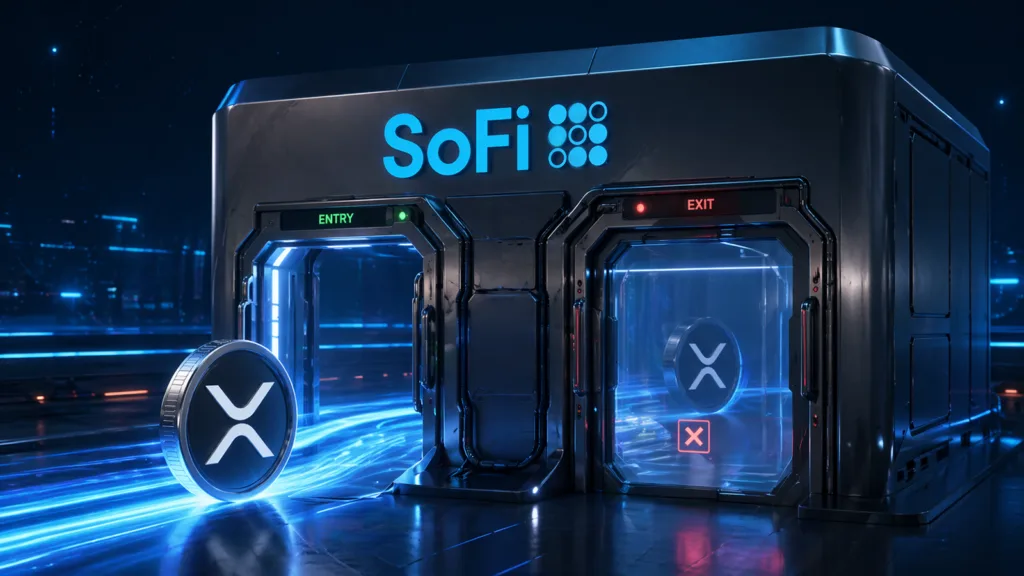



SoFi has expanded its crypto platform to include XRP deposits, although the change has received negative reactions among users since the company remains unable to transfer to external wallets.
The bank announced on Tuesday that it now accepts XRP as a deposit, adding to the list of digital assets it supports.
The rollout gives users another way to access XRP through SoFi Crypto. Still, the reaction was mixed because many crypto users view wallet transfers as a basic feature.

Without that option, customers can hold and trade XRP on the platform, but they cannot move the asset to self-custody or other crypto services. Some users said that limit reduces the value of the offering.
“XRP withdrawals aren’t allowed by SoFi. It’s basically only a spot ETF. Does nothing to help the XRP ecosystem,” Dan Thurman wrote on X.
That reaction reflected a broader concern from parts of the crypto market that custody restrictions can limit how a token is used beyond simple buying and selling.
SoFi adds XRP but keeps wallet limits
SoFi Crypto said it now supports XRP deposits, marking another step in the company’s digital asset business. The move adds access to one of the largest cryptocurrencies by market value and gives SoFi users a new option as interest in XRP remains strong across retail and institutional markets.
At the same time, the company’s platform rules remain a key point in the discussion. A post from SoFi’s support page confirmed that users cannot transfer crypto assets to outside wallets. That means customers cannot send XRP from SoFi to private wallets or other exchanges, even after the deposit feature went live.
A SoFi spokesperson told The Block that the ability to withdraw digital assets “will soon be available.” The company did not provide a public launch date for that feature. SoFi also did not immediately respond to an additional request for comment in the report.
The restriction matters because external wallet transfers remain central to how many crypto users manage digital assets. Traders often move tokens between platforms for trading, staking, payments, DeFi activity, and storage.
Furthermore, the primary complaint regarding SoFi XRP support was about control and not access. Users are now able to add XRP into the system, but not withdraw it to their personal wallets.
SoFi’s crypto business grows as XRP activity broadens
The XRP update comes as SoFi continues to expand its digital asset strategy. Last November, the company said it became the “first and only” nationally chartered bank to launch crypto trading. That move placed SoFi in a small group of regulated U.S. financial firms trying to link traditional banking with digital asset services.
The company has also reported financial growth outside crypto. It recorded its first billion-dollar revenue quarter in the fourth quarter of last year. Last month, it also partnered with Mastercard to use its SoFiUSD stablecoin to settle card payments across Mastercard’s network. Those steps show that digital assets remain part of SoFi’s broader financial services push.
Ripple, the main contributor to the XRP Ledger, welcomed SoFi’s support for XRP. The company said, “More access to XRP with SoFi means more people can participate, and that’s exactly how utility grows.” That response framed the listing as another point of access for retail users, even as criticism over wallet restrictions continued.
XRP remains the fourth-largest cryptocurrency by market value, at about $100 billion based on CoinGecko data. The token has stayed in focus as Ripple advances its post-quantum roadmap for the XRP Ledger and as new use cases expand across other networks.
XRP sees fresh use cases as market attention returns
Recent developments have added new attention to XRP beyond SoFi’s platform update. On April 17, Solana announced that wrapped XRP, or wXRP, went live on its network through Hex Trust and LayerZero. The setup allows users to bring XRP into Solana’s DeFi market without selling their holdings first.
Solana said wXRP is backed 1:1 by native XRP, with Hex Trust serving as custodian for reserves and LayerZero providing cross-chain infrastructure. That launch gives XRP holders another route into liquidity pools, decentralized trading, and yield-focused products on Solana-based apps.
Ripple’s native token has also attracted new market focus by analysts and on-chain observers. According to CoinGecko data, XRP traded at $1.43 at press time, with a 24-hour trading volume of about $2.5 billion. The token had lost 0.46 percent in 24 hours, but improved 4.79 percent in seven days.
Notably, Ali Martinez said XRP appears to be shifting from a bearish structure to a bullish one. The analyst pointed to a buy signal on the daily SuperTrend indicator and said whales accumulated about 360 million XRP over the past week, based on Santiment data.