




XRP holders can now use their tokens in Solana’s DeFi market without selling the asset first. Solana announced on April 17 that wrapped XRP, known as wXRP, is now live on its network through Hex Trust and LayerZero.
The launch gives XRP a new route into decentralized trading, liquidity pools, and yield products on Solana-based apps.
Solana said wXRP is backed on a 1:1 basis with native XRP. Hex Trust acts as the regulated custodian for the XRP reserves, while LayerZero supports the cross-chain infrastructure used to move the asset between networks.

Meanwhile, the move links two major blockchain ecosystems that have built different user bases. XRP has long focused on payments and transfer efficiency, while Solana has grown around decentralized apps, trading, and token activity.
The launch may give XRP holders broader on-chain utility while bringing a new asset into Solana’s active DeFi market.
wXRP launches on Solana
Solana confirmed that wXRP is now available on its blockchain as a wrapped version of XRP. The token gives users a Solana-based representation of XRP that can move across decentralized applications while remaining redeemable for native XRP held in custody.
According to the announcement, each wXRP token matches one XRP held in segregated custody accounts by Hex Trust. The custodian issues or burns the wrapped token when users deposit or redeem the underlying asset. That setup aims to keep the token fully backed at all times.
In a post on X, Solana wrote that “wXRP is live on Solana via Hex Trust and LayerZero.” The network also said the asset is already available across selected apps in its ecosystem.
That immediate rollout gives the token a starting point in some of the chain’s most used wallets and exchanges.
The product did not arrive without preparation. In December, Hex Trust said it planned to issue and custody wXRP to expand XRP use in DeFi and cross-chain applications. At that time, the firm said the asset would become available on Solana, Ethereum, Optimism, and HyperEVM.
RippleX senior vice president Markus Infanger had also backed that plan in earlier comments.
“There’s growing demand to use XRP across the wider crypto ecosystem and institutions, and so we are excited to see Hex Trust address this demand,” he said.
He added that the move fit with Ripple’s broader work around RLUSD and regulated access to DeFi.
XRP targets new liquidity through Solana apps
The Solana launch gives XRP access to one of the busiest decentralized trading markets in crypto.
Until now, XRP activity has remained heavily concentrated on centralized exchanges and on its native ecosystem. With wXRP, the asset can now reach traders and liquidity providers active on Solana-based platforms.
Solana said the token is now supported on Phantom, Jupiter Exchange, Meteora, and Titan Exchange. That gives users multiple entry points for trading and liquidity use from the start.
Market participants may also expect expansion into lending and other DeFi services over time, though actual usage will depend on demand and available pairs.
The launch may also help XRP expand beyond its traditional role in payments. XRP has often been tied to cross-border transfer narratives and institutional use cases. On Solana, it can enter a market shaped more by retail trading, token swaps, liquidity pools, and rapid asset rotation.
XRP price rises as market mood improves
XRP traded near $1.48 after the launch, posting a daily gain of more than 3 percent and an increase of about 9 percent over the past seven days (per CoinGecko’s data).
Daily trading volume stood above $4.35 billion, showing that interest in the asset remained active during the announcement.
The token’s move also came as the wider crypto market advanced on easing geopolitical tension in the Middle East. That broader recovery supported both XRP and SOL during the same session.
XRP briefly moved above $1.50, while Solana also posted gains before pulling back from intraday highs.
Technical indicators pointed to improving short-term momentum. XRP’s RSI sat near 65, placing it in the upper neutral range and close to overbought territory. That reading suggested stronger buying pressure, though not yet extreme conditions.
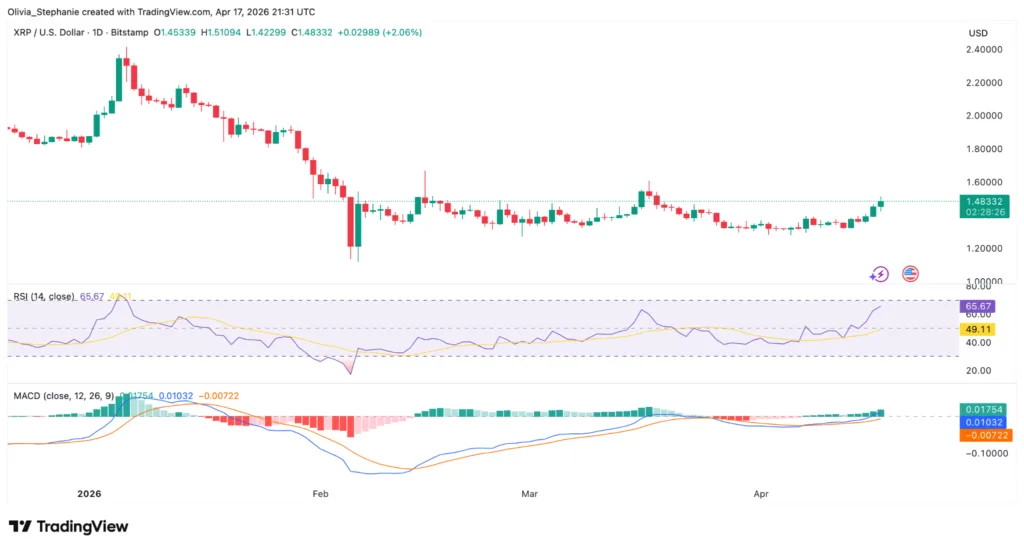
Moreover, the MACD also turned positive, with the MACD line moving above the signal line and green histogram bars expanding. Those signals showed that bullish momentum was building after a long consolidation phase.