
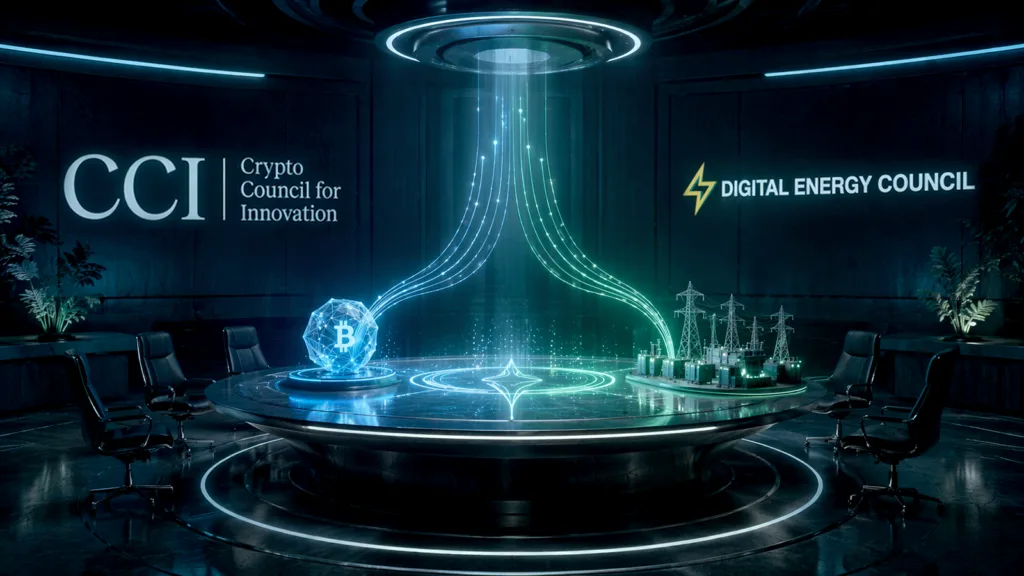



The Crypto Council for Innovation has added the Digital Energy Council to its organization, giving the group its first unit focused fully on energy policy.
The move brings crypto policy work and digital energy advocacy under one structure as debate over mining, electricity demand, and U.S. infrastructure keeps growing.
CCI announced that the Digital Energy Council will henceforth become a special working group within the larger organization. The policy areas covered by the group will include energy development policies, grid resiliency, U.S. competitiveness, and national security.

The announcement was made on April 17 with industry groups still demanding more influence in energy and digital asset policy discussions.
CCI expands into digital energy policy
CCI described the move as an acquisition that joins its policy and advocacy work with DEC’s focus on mining, energy security, and related technologies.
According to the organization, the integration comes at a time when electricity demand is rising alongside the growth of crypto mining, AI data centers, and other compute-heavy industries.
Hunter Budd, the interim executive director of DEC, will help lead the transition as DEC’s operations move into the broader CCI framework.
CCI said the goal is to create a more coordinated approach to advocacy as lawmakers, regulators, and industry groups debate how the U.S. should manage energy use tied to digital infrastructure.
CCI Chief Executive Officer Ji Hun Kim said energy policy has become central to the future of digital assets and blockchain technology.
”Energy is foundational to the future of digital assets and blockchain technology. By bringing the Digital Energy Council into CCI, we are ensuring that the industry has a unified, authoritative voice on the critical policy issues at the intersection of energy and digital innovation,” he noted.
Moreover, Kim added that the group wants to build a stronger policy presence around grid resilience, mining practices, and energy modernization.
His remarks placed the move within CCI’s broader effort to expand beyond core crypto regulation and take a more active role in infrastructure policy linked to digital assets.
Mining and power demand shape the new agenda
CCI said the acquisition comes as energy demand rises across several technology sectors. The group pointed to digital asset mining, AI data centers, and other compute-intensive services as major drivers of this shift.
In addition, it said data centers already account for nearly 5 percent of U.S. electricity use and projected that figure could more than double over the next five years.
The organization also said global data center power demand could rise by as much as 165 percent over the next decade.
CCI used those figures to argue that energy policy and digital infrastructure policy can no longer be treated as separate issues. The group said a unified voice is needed as governments respond to those trends.
The Digital Energy Council has long argued that mining and energy development should work together rather than be treated as opposing forces. Budd repeated that position in the statement released on Friday.
”The Digital Energy Council was founded on the belief that digital asset mining and energy development need to work together to strengthen America’s energy infrastructure,” he stated.
He added that joining CCI gives the mission a larger platform and more access to policy expertise. According to Budd, the combination will help keep energy issues at the center of the digital asset agenda as the sector expands and power demand continues to rise.
Industry groups back a unified policy structure
A number of industry players welcomed the initiative in press releases to accompany the announcement. Amanda Anderson, global head of public policy and government relations at Block, told CCI joining the coalition would enhance coordination in the digital asset and energy industry.
She claimed that the move would enhance industry involvement with policymakers and contribute to the work related to grid resilience, energy development, and U.S. leadership in technology.
Block claimed that it has enabled both groups and is developing ASIC-based technology to enhance efficiency, reliability, and uptime in large-scale data centers.
The partnership was also associated by the company with the attempts to decentralize the bitcoin mining industry and facilitate viable policy initiatives on digital infrastructure.
CleanSpark also backed the decision. Vice President of Policy and Government Relations Margeaux Plaisted said the merger of DEC into CCI reflects a broader need for one industry voice on energy and digital infrastructure policy.
She noted that the combined group could better support pro-growth and evidence-based policies at a time when energy reliability and technology investment are drawing more attention.
Galaxy made similar points in its statement. Natalia Li, the firm’s head of policy, stated that the link between energy policy and digital infrastructure is becoming stronger as demand for AI-ready data center space increases.
She argued that a coordinated policy approach will be needed if the U.S. wants to stay competitive while supporting responsible energy development.
Policy environment shifts under a new administration
The move follows a shift in tone on crypto and mining by Washington as well. During the Biden administration, federal agencies expressed concern over the amount of energy consumed by crypto mining.
The U.S. Department of Energy started investigating mining firms regarding their electricity use at a time when officials alerted that increasing bitcoin costs may encourage more mining and strain electricity infrastructures.
That approach drew criticism from parts of the crypto industry, which argued that mining can support grid stability and make use of underused energy resources.
The debate has remained active as mining firms and advocacy groups try to shape how lawmakers view the sector’s role in energy markets.
Under the President Trump administration, the policy approach has become more favorable to digital assets. Industry groups have pointed to a stronger focus on keeping crypto innovation in the U.S.
Last month, Republican senators introduced a bill aimed at supporting crypto mining and writing President Trump’s executive order on a strategic bitcoin reserve into law.