
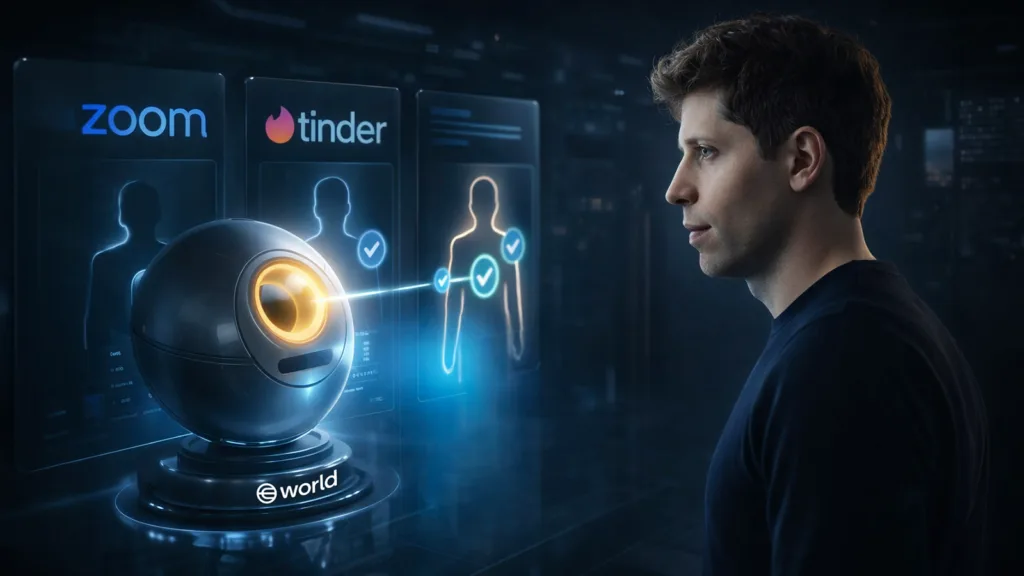



World, the biometric identity project co-founded by OpenAI chief Sam Altman, has rolled out a major upgrade to its World ID system.
With this update, World is moving beyond basic identity checks and turning World ID into a broader “proof of human” system for consumer apps, business platforms, and artificial intelligence use cases.
The company shared the announcement during its Lift Off event, where Altman and World president Alex Blania spoke to developers and partners. World’s network now has nearly 18 million verified users in 160 countries.

The new version also brings major changes to the protocol itself. World ID now runs on an account-based system, which gives users more control and stronger protection.
It supports multiple keys, key rotation, and account recovery features, so users can better protect their accounts or regain access if something goes wrong.
The upgrade also keeps privacy at the center. It uses zero-knowledge proofs to help people prove they are real humans without sharing personal details. It also adds one-time-use codes to reduce tracking across apps and services.
New app and tools for everyday use
World has also launched a new World ID app, and it is now open for public beta testing.
The app gives users one simple place to manage their digital identity. They can decide which services can use their verification and can also add or remove ways to log in or confirm their identity.
At the same time, World has made its Software Development Kit open-source. It gives developers the tools to add World ID verification to their own apps more easily.
The company also announced new uses for the system on well-known platforms. Tinder now offers a “verified human” badge for people who complete World’s Orb check, which could help lower the number of fake profiles.
Zoom has added a feature called “Deep Face” to help confirm that people in video calls are real and not AI-made fakes.
Brendan Ittelson, chief ecosystem officer at Zoom, said in a post on Friday that, “Zoom has always prioritized security and trust as core to our platform.”
“This collaboration expands the choices available to our customers by bringing innovative, security-enabling capabilities into the Zoom ecosystem, helping them confidently navigate the next era of AI-driven communication,” Ittelson added.
In addition, DocuSign is using World ID to help make sure real people sign agreements. Outtake Verify uses the same system to confirm that verified people send business emails.
World also introduced Concert Kit, a tool that checks if a buyer is a real person before they can buy a ticket. This helps stop bots from buying many tickets and reselling them at higher prices.
Beyond enterprise use, World ID is also moving into gaming. Companies such as Razer and Mythical Games are using it to reduce bot activity and create a fairer experience for real players.
Together, these tools bring in “human continuity”, which means platforms can keep checking the real person behind an action, not just the account or device.
AI agents support and enterprise security
As AI tools become more common, World has rolled out AgentKit. This feature enables a real, verified person to give an AI assistant permission to act on their behalf.
Simply put, when an AI sends a request, the system can check that a real person approved it. This helps stop misuse while still allowing useful AI tasks.
World has also introduced a fee model for apps that use World ID. Regular users will still use the system for free.
Under this model, apps may pay two types of fees. One is a credential fee set by the issuer. The other is a protocol fee set by the network.
World said most apps may be charged based on monthly active users. This makes it easier for companies to compare the cost with the value they get from proof of human.
For payments, Web3 apps can fund wallets on-chain. Web2 platforms can use external services to handle payments in traditional currency.
World said these fees will run automatically on the blockchain. Some of the money will help operate the network, while some may be used to burn tokens. The World Foundation will handle this setup at the beginning.
World’s rapid growth has also brought strong criticism. Sam Altman’s project has faced privacy concerns and even restrictions in countries like Thailand, Kenya, France, and Germany.
Most concerns focus on biometric data collection, user consent, and the storage and handling of sensitive identity data.