
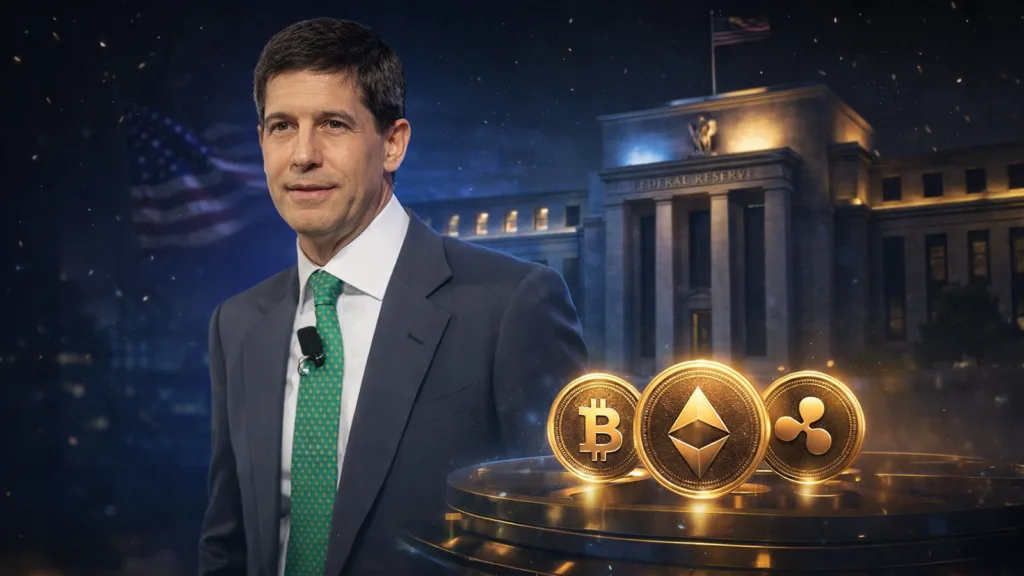



Kevin Warsh, President Donald Trump’s nominee to lead the Federal Reserve, has disclosed a portfolio that includes early-stage exposure to crypto-related firms, AI companies, and venture funds.
The filing, submitted to the US Office of Government Ethics, comes as the Senate prepares to review his nomination to replace Federal Reserve Chair Jerome Powell.
The disclosure has drawn attention because Warsh is in line for one of the most powerful roles in US economic policy. Lawmakers are expected to examine his finances, past business ties, and public views as the confirmation process moves forward.

Filing shows broad tech and crypto exposure
Warsh’s ethics filing lists interests connected to several digital asset companies and blockchain projects. The names include Compound, Dapper Labs, dYdX, Lighter, Polychain, Solana, Optimism, and other firms tied to trading, infrastructure, and crypto investment activity.
The document also names smaller startups such as Eulith, Lemon Cash, OnJuno, and Ridian. Moreover, the same filing includes positions in AI and other technology businesses, including Delphi, Conversion, Factory, and Glue.
Reuters reported on Tuesday that Warsh’s total assets exceed $100 million, though several crypto and AI entries do not include value ranges. The disclosure also does not show reportable income from many of those positions.
That structure has shaped how observers read the filing. The list contains many crypto-linked names, but it does not show large direct holdings in publicly traded digital assets. Instead, the document points to exposure through private or early-stage vehicles.
Additionally, the filing also shows larger holdings outside crypto. Those include more than $50 million in the Juggernaut Fund and more than $10 million in consulting income tied to Duquesne Family Office, the investment firm of Stanley Druckenmiller. Those positions account for a large share of Warsh’s reported wealth.
Senate review nears as Powell term ends
Warsh’s disclosure landed as the Senate Banking Committee moved closer to a hearing. Punchbowl News and Politico reported that he is expected to appear before lawmakers on Tuesday.
Committee Chair Tim Scott told Fox Business that the hearing and later Senate action could move ahead within the next few weeks.
“I believe that we are getting closer and closer to that being a reality in the next few weeks that allows us to move forward as a committee and vote Kevin Warsh to the floor of the Senate that will get him confirmed in the next several weeks,” Scott noted.
His remarks gave the clearest public timeline so far for the nomination process.
President Trump announced Warsh as his choice in January and formally sent the nomination to the Senate in March. The White House asked the Senate to confirm him for a four-year term as chair and a 14-year term on the Board of Governors beginning February 1, 2026. If lawmakers approve the nomination, Warsh will replace Powell when Powell’s term ends in May.
The committee still faces political hurdles. Senator Thom Tillis has said he will not support advancing nominees until a Department of Justice probe involving Powell is resolved.
Scott said he believes Tillis “will be a yes on Kevin Warsh,” but the committee must still clear the nomination before it reaches the full Senate.
Venture-style crypto exposure
In a post on X, Fox Business journalist Eleanor Terrett said the filing shows “early stage investments held through an employment-linked vehicle that spans a wide range of tech, including some crypto infrastructure.”
She pointed to holdings linked to Compound, Optimism, Blast, and Solana, along with firms tied to trading systems, investment platforms, AI, biotech, and other sectors.
Terrett said the positions “appear small, illiquid, and generated no reportable income,” which, in her view, points to “indirect venture style exposure rather than direct, liquid holdings.” She also wrote that the filing still ranks among “one of the more crypto heavy disclosures we’ve seen from a would-be Fed Chair.”
Her comments focused on the type of exposure rather than the size of any single asset. The filing does not present a picture of a nominee holding large personal token positions.
Instead, it shows a portfolio with venture-style links to companies working across crypto and technology markets.
That reading also fits the way the disclosure is written. The document names many firms, but it leaves several entries without clear value bands and shows no reportable income from those positions. That combination has made the filing notable for its breadth rather than for any one holding.
Crypto reaction widens the story
Terrett’s post also drew criticism on X. William Carpenter asked why she felt it was necessary to report Warsh’s holdings.
“Because they’re public documents that are about to be scrutinized at his Senate hearing next week,” Terrett replied.
Her response pointed to the role these filings play during confirmation reviews. Additionally, the exchange quickly widened into a larger discussion about crypto’s place in mainstream finance.
Market commentator Luke Martin compared the moment with a 2017 scene in which a “Buy Bitcoin” sign appeared behind then-Fed Chair Janet Yellen during a public event.
He wrote that a Fed chair nominee in 2026 now shows links to “SOL, layer-2 tokens, prediction markets, NFT platforms, defi, neobanks, BTC lightning…”
“The era of crypto as fringe finance is over. The new paradigm of all finance moving onchain is just beginning,” Martin added.
His comment reflected market sentiment rather than policy analysis, but it captured why Warsh’s filing has attracted attention beyond Washington.
Warsh has also spoken about digital assets in the past. Earlier reports said he viewed bitcoin as “an important asset that can help inform policymakers.”
He has also been linked to Bitwise through advisory and investor roles and to Basis, an algorithmic stablecoin project that later shut down.