
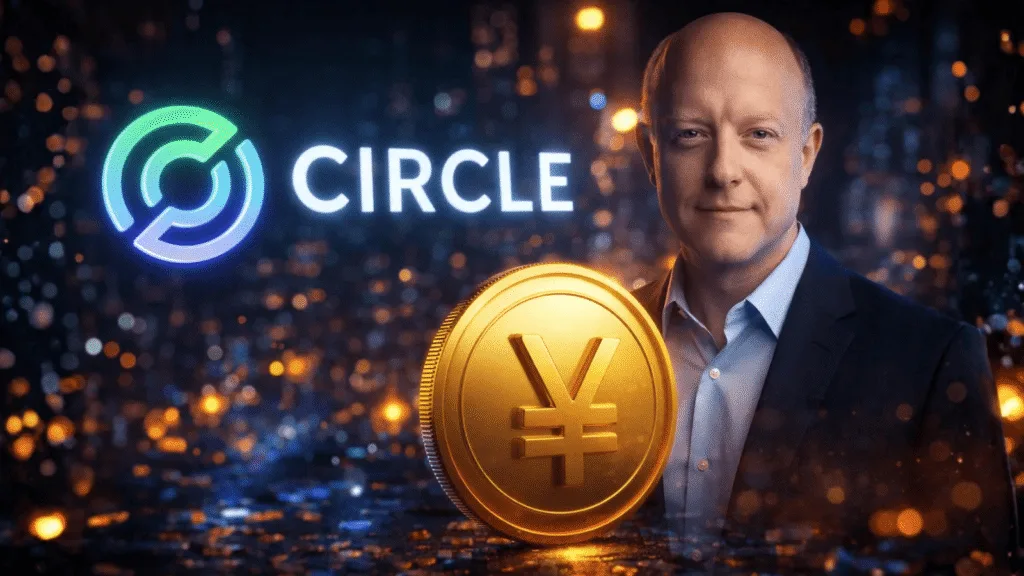



There’s a certain irony in the world’s largest regulated stablecoin issuer making the case for China’s currency going digital on the blockchain. But that’s more or less what Jeremy Allaire did this week in Hong Kong, and the argument is worth taking seriously.
Speaking to Reuters on the sidelines of what appears to be an extensive Asia tour, Allaire had also been in Seoul days earlier meeting with Korean bank executives. The Circle co-founder and CEO said he sees “tremendous opportunity” for a yuan-backed stablecoin.
He put a timeline on it, too: three to five years. “If there’s currency competition,” he said, “you want your currency to have the best features possible. This is becoming a technological competition.”

That framing doesn’t seem subtle. It’s a direct dig at the dollar’s current grip on the stablecoin market, and a quiet acknowledgement that the geopolitical race for digital currency infrastructure is already underway.
The Yuan’s long road to stablecoin relevance
China has been trying to push the yuan’s global role for years, with mixed results. The digital yuan, or eCNY, the People’s Bank of China’s central bank digital currency, has processed cumulative volumes in the trillions of yuan domestically, but its international footprint remains limited.
Part of the problem is structural in the sense that China’s domestic payment ecosystem, dominated by Alipay and WeChat Pay, is already highly efficient. The eCNY doesn’t have an obvious home problem to solve.
Where it struggles is cross-border. And that’s precisely where stablecoins have an edge. A yuan-backed stablecoin, particularly one pegged to the offshore yuan, or CNH, could, in theory, plug into existing global payment rails, decentralized finance protocols, and digital trade settlement in ways that a CBDC issued by a central bank is not really designed to do.
Allaire has made this argument before, telling the South China Morning Post in 2023 that stablecoins may offer a more immediate path for yuan globalization than the eCNY. His comments this week suggest that view has only hardened.
Reuters also noted that this is not a new idea in Chinese policy circles. Back in August 2025, Reuters itself reported, citing sources with direct knowledge that Beijing was actively considering a yuan-backed stablecoin as a tool to expand the currency’s reach globally. Nothing official has emerged since, but the report at least suggests the conversation is happening at a level that matters.
The complication, of course, is that China banned cryptocurrency trading and mining in 2021. Any move toward a yuan stablecoin would require a meaningful policy reversal, or at minimum a carefully carved-out exception, probably routed through Hong Kong, which has been building out a formal stablecoin licensing regime since its Stablecoins Ordinance took effect in August 2025.
The Hong Kong Monetary Authority had signaled it expected to issue an initial wave of stablecoin licenses as early as March 2026. Beijing has expressed reservations about the pace of that process, but it hasn’t moved to block it outright, which may say something.
Allaire called Hong Kong a hub for cross-border payments and settlement, and said Circle sees real potential in working with Hong Kong dollar stablecoins to connect them into global platforms.
Reading between the lines, Hong Kong appears to be Circle’s preferred onramp for deeper Asia-Pacific integration, a place where Western regulatory standards and Chinese financial interests overlap just enough for business to get done.
U.S. regulatory turbulence looms in the background
Allaire’s Asia comments come at an awkward moment for Circle on the domestic front. The CLARITY Act, the U.S. stablecoin legislation that has been stuck in procedural limbo for months, contains language that would restrict yield-like rewards on passive stablecoin holdings.
When a draft version leaked in March, Circle’s stock dropped 20% in a single session, its worst day since going public. The concern is that a significant chunk of USDC’s attractiveness to retail and institutional holders is tied to the yield mechanics facilitated through distribution partners like Coinbase.
Allaire acknowledged the regulatory headwind in Hong Kong, suggesting that any marketing restrictions in the CLARITY Act would likely hit stablecoin distributors harder than issuers, a framing that positions Circle as more insulated than platforms like Coinbase from the bill’s potential effects. Whether that assessment holds up as the legislation moves through the Senate Banking Committee remains to be seen.
For now, though, Circle’s CEO appears to be looking east as much as he’s watching Washington. USDC recorded “several billion dollars” in transaction growth following the outbreak of the U.S.-Iran war, Allaire told Reuters, as demand for portable digital dollars spiked amid heightened geopolitical risk.
That kind of demand signal, stablecoins as a safe harbor when things get unstable, is precisely the use case Circle has been building toward. A yuan stablecoin, if it ever materializes, would complicate that picture. It would also validate everything Allaire has been saying about this market becoming a genuine contest between currencies, not just between blockchains.