
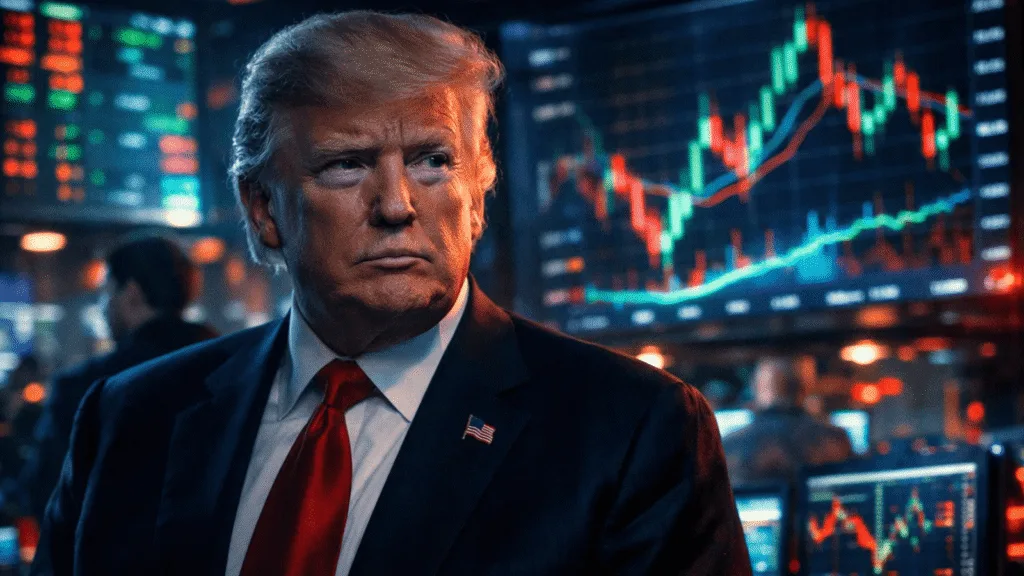



Markets used to remain inactive while they waited to receive inflation data and central bank meeting results and quarterly earnings reports and scheduled structured information which could be analyzed using established frameworks. Markets today operate without any waiting period because they display immediate responses to market events.
The markets show increasing tendency to react through sudden emotional announcements which disrupt financial operations worldwide. A sentence appears. A tone shifts. A position reverses.Just within a few moments all market futures experience a sudden increase while cryptocurrency assets become liquidated and gold gains market interest and the dollar undergoes market adjustment.
The economic environment remains unchanged because the world economy continues to operate without any development of new production facilities or implementation of new policies or alterations in actual economic performance. Yet trillions in market value are repriced.The sound does not constitute background noise. The sound represents a fundamental system change. The mood market now controls our operational activities.

From data markets to narrative markets
The past allows market systems to use structured input modeling. Inflation data, employment figures, GDP growth these were the anchors. The only way to estimate uncertainty existed because all variables could be measured. The original structure has completely disappeared.
A market currently operates under the main influence of story-based elements which exist before any numerical information. Donald Trump can make an announcement that includes tariffs and geopolitics and monetary policy and corporate pressure which creates an immediate impact on market expectations.
The market no longer asks, “Is this policy confirmed?” The market now investigates how people will respond to present situations. The new method of decision-making enables faster information distribution through narrative development which operates independently of data verification. The audience only needs to pay attention to the information presented. The result is a market that is no longer anchored to reality in real time. The system bases its operation on personal interpretation.
The millisecond economy
The market reaction speed remains beyond human capability because it functions through computational processes. Current market systems establish connections to databases which conduct language-based analysis. Natural language processing models process multiple media sources including headlines and speeches as well as posts and interviews to extract sentiment and keywords and detect directional bias within milliseconds. The systems operate without waiting to acquire human-like understanding of context. The system predicts outcomes through three dimensions which include probability and direction and urgency.
When Donald Trump makes a statement, it is not simply heard. The system processes his statement into three elements which include a parsing step and scoring step and trading step that occurs within seconds.
The system establishes a structure which creates several simultaneous reactions. The first step involves algorithms taking action. The second step occurs when institutional traders respond to the movements driven by algorithms. The final step begins when retail participants see the price change and make their decisions. The market already completed its initial movement at the time when average participants read the headline.
Volatility without fundamentals
The mood market displays its most distinct characteristic through the appearance of market fluctuations which happen without any established reasons for their existence. The market experiences sudden price changes which occur because of each market event. The market experiences price changes because people temporarily change their expectations about upcoming supply and demand.
The sequence starts from a declaration which shows an upcoming policy change possibility. The market immediately assesses that new information about possibilities. The market experiences a decline in liquidity because traders who want to assess signal trustability withdraw from trading.
The market thinning process creates greater price fluctuations which make the initial statement appear more essential. The movement becomes its own justification. Modern markets operate under a false belief that one event causes another. The market first shows price changes. After that, people develop their explanations.
The reflexivity loop
The sequence which follows consists of an uninterrupted sequence which loops back to its starting point. The first action of the sequence begins with a statement. Media coverage of the initial move creates an expanded narrative which reaches a larger audience. The larger audience responds to the message without understanding its original subtlety.
The secondary reaction creates price changes which market participants see as proof of a major market transformation. The cycle sustains itself through its own operations. Donald Trump serves as a information source but he exists as a central element within the loop. His statements function as initiation points which lead to further interpretation within the system of feedback. The market no longer responds to actual events. The market now assesses how people respond to actual events.
Political psychology as a market variable
The central element of this transformation introduces a change which previous financial models considered to be impossible because people now regard personality as a commodity which they can trade.
Unpredictable outcomes create new chances for success, which used to bring about reduced risk through established patterns. The financial markets use unpredictable elements to create revenue through the resulting market fluctuations.
The market starts to evaluate both policy results and behavioral tendencies which include possible changes in Donald Trump s political stance and his unexpected speaking points.
This represents a major transformation. The current market situation shows that operational economic realities now drive market valuation, which includes real-time human psychological assessment. The question now has shifted from asking about upcoming policy decisions to asking about future statements.
Derivatives and the acceleration of impact
The central element of this transformation introduces a change which previous financial models considered to be impossible because people now regard personality as a commodity which they can trade. Unpredictable outcomes create new chances for success, which used to bring about reduced risk through established patterns. The financial markets use unpredictable elements to create revenue through the resulting market fluctuations.
The market starts to evaluate both policy results and behavioral tendencies which include possible changes in Donald Trump s political stance and his unexpected speaking points. This represents a major transformation.
The current market situation shows that operational economic realities now drive market valuation, which includes real-time human psychological assessment. The question now has shifted from asking about upcoming policy decisions to asking about future statements.
Cross-asset shockwaves
The first statement which starts the discussion will lead to an outcome which extends beyond its initial boundaries.Equity markets react first, reflecting changes in risk sentiment. The crypto market experiences increased price fluctuations because traders use leverage and speculative positions.
Gold moves as capital seeks safety, while the U.S. dollar adjusts based on shifting expectations of policy direction and global stability.The reactions between these two things do not occur separately. The two elements connect through three factors: liquidity, positioning, and shared narratives.
A single declaration from Donald Trump can therefore propagate across the entire financial system, creating synchronized movement in assets that, under normal conditions, might not move together. The current environment does not have a permanent system to establish correlation. The phenomenon arises because of specific events.
The speed of interpretation risk
The primary danger which exists in the mood market operates through two elements because volatility itself does not present a threat. It is the speed at which volatility is interpreted.In traditional markets, risk could be managed through analysis. The available period allowed complete information processing which included historical data comparison and view development.
Current time constraints make it impossible to complete necessary work. Market movements occur before human participants can grasp the complete implications of a statement to the point that multiple market shifts have occurred.
The situation establishes a fresh kind of structural disadvantage which affects all participants. People who depend on understanding their work will arrive at their jobs after the scheduled time. The market has become a competition not of insight, but of reaction latency.
The illusion of control
The transformation brings forward an advanced consequence which extends beyond its immediate impact. Markets experience rapid changes when their driving narratives shift within seconds and those narratives depend on personal behavior instead of institutional operations.
Control becomes uncontrollable because institutional processes no longer operate as expected. The process of policy development now occurs through public declarations which undergo multiple updates and complete overhauls.
Markets attempt to price this phenomenon yet the actual pricing remains unpredictable because the fundamental signal maintains its unpredictable nature. Market participants start developing the conviction that they respond to actual occurrences. Market participants respond to a dynamic representation of reality which keeps changing.
A new market regime
The current situation presents an ongoing problem which exists beyond its temporary existence. The current market environment shows unverified information to be common practice because people react to news before they verify the facts and because market liquidity conditions can change within seconds and because market participants use narratives to decide their actions without any advance notice.
The current political environment treats Donald Trump as more than a political figure because he acts as a force that moves markets to create new financial outcomes which spread throughout the international economic system. The market no longer functions as a passive mechanism that shows economic activities. Human signals now serve as the main source of market operations.