




The rhetorical landscape of the global financial sector was shaken this week when a Chinese professor, Jiang Xueqin, ignited a new debate by labeling Bitcoin a “CIA operation”. In one of the most high-profile technical talks, the professor made the theoretical claim that the world’s most important digital asset could be a strategic intelligence tool.
Given the sophistication of the code, Xuegin suggested it was created by a state architect rather than an individual. This controversial position has sparked heated discussion amongst cryptographers and institutional investors around the world.
The Intelligence Theory and Bitcoin
The notion of a Bitcoin CIA operation isn’t new. It has circulated for years, in large part because Bitcoin’s mysterious creator, Satoshi Nakamoto, has never been identified. Some have speculated that governments or spy agencies may have been involved due to their anonymity.

Jiang Xueqin described Bitcoin as a possible intelligence-linked endeavor during his recent analysis of digital sovereignty. He doubted the Satoshi Nakamoto myth, pointing out that the name itself, in some linguistic readings, indicates ‘central intelligence’. Xuegin says the key goal of such an operation would be to establish a transparent, traceable ledger. Although pseudonymity is cheered by enthusiasts, the professor cautions that the ledger is permanent and that this is the objective of long-term surveillance.
Furthermore, his comments raised concerns about where Bitcoin’s blockchain data is physically stored across the global network. According to Xueqin, although the protocol is decentralized, the underlying hardware infrastructure is typically provided by centralized cloud providers. If these hardware hubs are compromised by intelligence services, the network’s hypothetical autonomy may be compromised. This perspective forces a re-evaluation of the “trustless” nature of the current digital financial ecosystem.
Decentralization risks for Bitcoin
The comment has rekindled discussions over decentralization and trust in cryptocurrency. Experts are now scrutinizing the physical distribution of nodes and the concentration of mining power.
Should Bitcoin be some sort of Trojan horse, the consequences of capital flight and the evasion of sanctions globally would be enormous. According to Xueqin, a regulated digital currency can enable agencies to track black-market flows more accurately than ever.
Bitcoin price analysis and blockchain.
Beyond geopolitical theories, the market itself is now responding to these narrative shifts with price volatility. The Bitcoin price is pegged by institutional adoption and halving-cycle fundamentals, despite the label of a so-called CIA operation. Bitcoin is currently trading at $74,378.
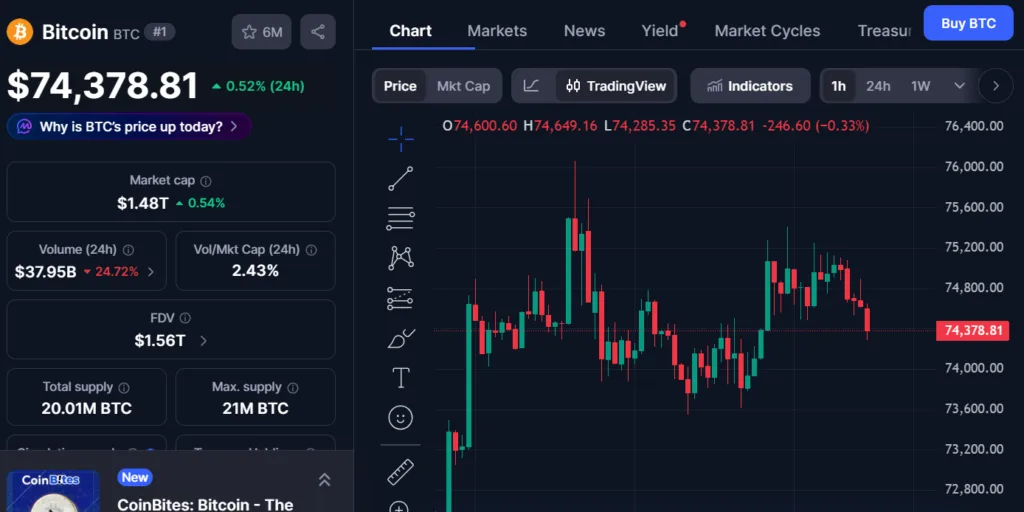
On the daily chart, $BTC has broken above a long-standing downtrend line around the $72K–$74K zone, accompanied by stronger volume. That combination usually signals that sellers are losing control, at least in the short term. It’s the first real sign of structural improvement after months of compression.
Prospects of the network
Ultimately, Jiang Xueqin’s assertions highlight a growing skepticism toward Western-originated technologies in the East. With the ongoing development of the Bitcoin network, the need in genuinely “sovereign” hardware is expected to grow. Whether the protocol began in a basement or a government lab, its impact on global finance is undeniable.
Additionally, a new Bitcoin Improvement Proposal, or BIP, has introduced a structured plan to transition the network away from address types that could be at risk if quantum computing advances to the point of compromising today’s cryptography.
The digital gold story is still compelling, but Xuegin’s frontman theory puts a spin on it. Professional investors would be encouraged to track the distribution of nodes and protocol updates to observe any signs of centralization. With the increasing Bitcoin age, the border between financial freedom and state surveillance is becoming even thinner. The code will prove to be a way to freedom or an ingeniously designed trap; only time will tell.