




Markets do not experience breakdowns at the precise time when demand ceases to exist. Markets only experience breakdowns when actual supply delivery surpasses the amounts which market participants had predicted. The schedule which governs crypto operations has the designation of unlock. Traders tell a straightforward story about their trading practices. When enough people buy an asset its value will rise. When buyers stop purchasing an asset its value will decline.
The explanation requires additional information. The essential factor which determines token market value today extends beyond current asset demand because it depends on upcoming future asset distribution throughout tomorrow and throughout the next week and next month and next quarter. Market conditions experience change because token unlocks and vesting cliffs and treasury releases and emissions and scheduled distributions occur throughout the existing period before market sentiment experiences its primary downturn.
Some charts present a strong appearance while narratives maintain an optimistic tone and community members remain active yet the market continues to decline. The market does not constantly present an opposition to the narrative. The market reacts to incoming supply instead of following the narrative. The complete process of unlocks functions as follows. Markets experience crashes because people panic-sell their assets. The asset market crash occurs because its design creates decreasing scarcity which the market failed to evaluate correctly. Vesting operates as a key element which drives market development. The market system functions through narratives which create stronger structural elements than collective market beliefs.

The illusion of strength
The most unsafe optical illusion present in cryptocurrency markets creates a false perception of power which investors experience during lockup times. A token can maintain tight trading patterns while showing upward movement and developing a permanent customer base despite most of its total supply remaining inaccessible to traders. The market shows artificial strength because the price movement during this time period represents false indicators of market conditions which exist between actual product supply and available market supply.
The core error which participants usually make stands as their main mistake. They examine price volume funding and open interest data yet they neglect to answer one fundamental question about asset circulation which provides information about market supply. The presence of vesting exists to achieve specific purposes. CoinMarketCap defines vesting as the schedule that determines when new tokens enter circulation which typically occurs in multiple time-based batches after the token generation event.
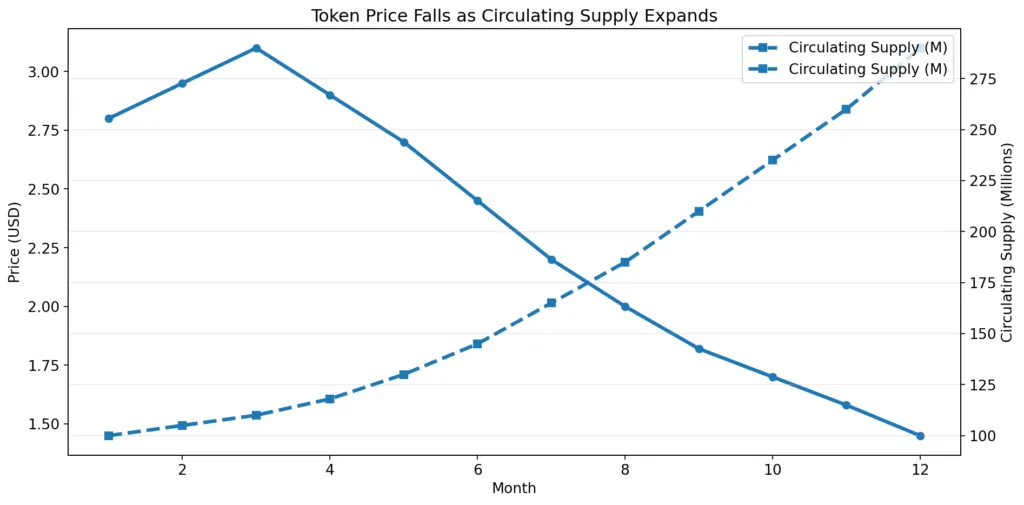
The purpose of token lockups exists to prevent immediate sell-offs while also ensuring that initial investors stay committed to the project’s long-term progress. Tokenomist presents token vesting as a time-based system which allows teams and investors and other stakeholders to gradually receive their locked allocations instead of receiving everything at once. Theoretical concept shows a healthy condition. The actual results show that most token markets begin their existence with limited available resources for trading. The system creates a false impression of strength which traders interpret as proof of strength.
Traders believe that an increase in prices shows strong market demand when in fact they observe only a limited portion of tradable assets which determines market prices. The same demand level requires market expansion before it can achieve results. The unlock trap presents itself. The market established equilibrium based on one float measurement which later showed excessive supply at another measurement. The total requirement for demand did not drop to lower levels. The denominator experienced alterations.
Why unlocks matter more than headlines
Crypto prefers explanations which depend on events. After a price drop, traders request a news story. People experience anxiety about major market changes. Crypto exchanges experience customer withdrawals. People feel disappointment about exchange-traded funds. People with large coin holdings sell their assets. People experience confusion about market regulations. All of these factors have potential effects on the market.
Unlock events differ from other events because they present predictable market interruptions. The events work as scheduled supply events which lead to increased market dangers. A surprise event can trigger panic, but a scheduled unlock can grind down price through anticipation, hedging, repositioning, OTC deals, and post-release distribution. The damage often starts before the actual date. Current market infrastructure shows how these events have gained importance as essential components.
The live dashboard of Tokenomist tracks daily linear releases from its system while displaying upcoming cliff unlocks. The April 13–19, 2026 digest from its system showed a deBridge unlock which controlled 12.9% of total circulating supply. The CoinMarketCap platform provides a specific calendar for token unlock events because it demonstrates that token unlocks have become an essential aspect of token market assessment. The crucial phrase there shows that its essential meaning exists in the percentage of circulating supply.
That is what matters. The size of a $10 million unlock remains unknown until various factors are assessed. The impact of an unlock on the market depends on how much supply will increase compared to its current value. The reason supply becomes more important than demand is explained by this concept. Demand displays irregular patterns which occur in specific time periods and presents difficulties for measurement. People can see scheduled supply patterns which operate through established systems and maintain unbroken operations.
The cliff, the drip, and the overhang
The appearance of supply pressure varies between different situations. Some projects release their tokens through cliffs which allow a substantial part of their tokens to be accessed directly. Other projects implement linear vesting systems which enable tokens to be released into the market through a gradual time-based process. The two factors create different effects on market psychology although both of them hold significance.A cliff unlock produces a date everyone can focus on. Traders position around it. Holders grow anxious. Market makers adjust. Analysts publish threads. The event becomes visible enough that it can sometimes be partially priced in.
Linear unlocks operate with less visibility while they deliver more dangerous effects. The process does not create a single moment of excitement. The system establishes an ongoing process which generates selling activity. The overhang creates a situation which prevents price increases because each upward movement encounters new selling opportunities. The chart shows two distinct outcomes which include complete destruction and temporary performance suspension. Arbitrum’s token supply documentation shows how market dynamics operate through its clean example of supply documentation.
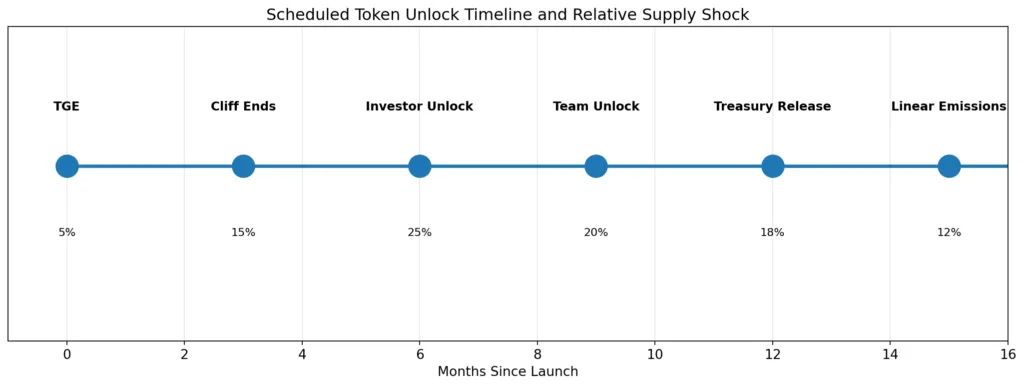
The team, contributor, and investor allocations unlock over four years starting from March 16, 2023, with the first unlock beginning on March 16, 2024 and continuing monthly. The Foundation allocation unlocks on a continuous schedule as well. The market process operates through continuous supply changes instead of a single supply event. The ZRO token of LayerZero shows its use as a practical demonstration of its functionality. The public tokenomics document states that strategic partners and core contributors must complete a three-year vesting period which includes a one-year lock period before receiving monthly unlocks during the following two years. The story delivers both valuation information and release details about the product.
The documentation from Sui demonstrates the same thesis using a different method of presentation. The vesting design of Sui company includes multiple tiers of distribution according to Sui company statement while existing investors had to wait one year before they could sell their initial investment during the one-year lock period which followed their initial investment.
Structural supply pressure is the real bear case
Most bear cases in crypto are written as failures of narrative. Users stopped caring. Revenue disappointed. Momentum faded. The founder lost credibility. Those things matter, but many token drawdowns are less dramatic and more mechanical.Structural supply pressure means price can underperform even when the project continues to execute. The protocol may grow.
TVL may rise. The community may expand. Daily active addresses may trend higher. But if circulating supply grows too quickly relative to real, absorbable demand, price can still weaken.This is the advanced layer of tokenomics most retail traders ignore. They think in terms of whether a project is “good.” The market often cares more about whether the supply schedule is survivable.Messari highlighted this broader issue when it referred to a roughly $55 billion unlock overhang expected across altcoins over the next two years in a 2025 report.
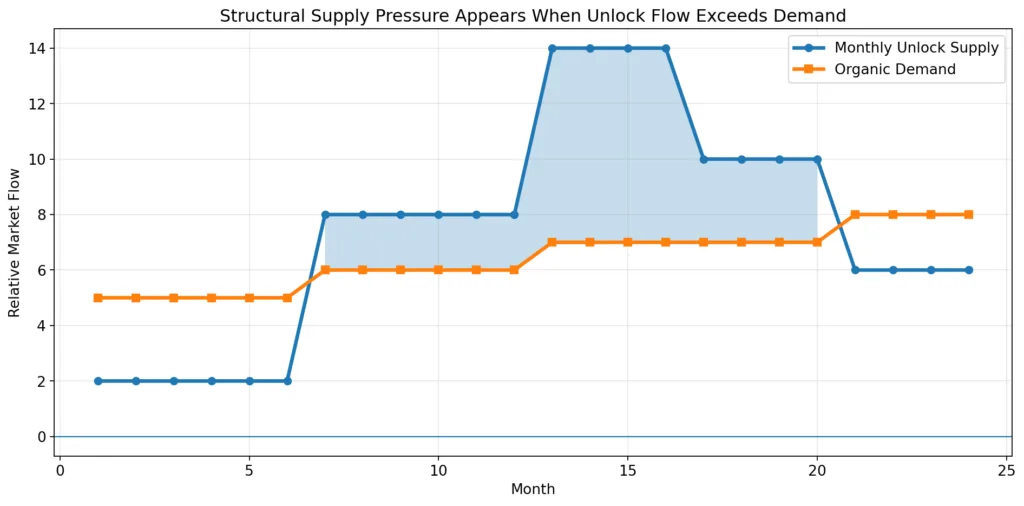
Tokenomist’s January 26–February 1, 2026 digest also noted that ONDO had recorded the largest cumulative unlock over the previous 30 days and that its price continued to react negatively under mounting supply pressure. CoinMarketCap’s January 2026 unlock coverage likewise described a $5.5 billion monthly wave led by ONDO and explained that large releases can influence short-term price dynamics, especially when liquidity is thin or sentiment is fragile.That is the key idea. Supply does not need to be apocalyptic to be damaging.
It only needs to be larger than the market’s capacity to absorb it without lower prices.And absorption is not just about spot buyers. It depends on exchange liquidity, slippage tolerance, derivative positioning, staking rates, treasury behavior, insider discipline, and whether unlocked holders choose to hold, borrow against, hedge, or sell. The unlock may not all hit the order book directly, but it still changes incentives across the system.
Demand is not a magic shield
The market shows a repetitive pattern which includes the expression of strong demand which will consume the unlock. The statement holds true in some cases but people repeat it without showing proof in most situations. Demand becomes a protective barrier only when it possesses sufficient strength to withstand continuous supply introduction at any price point.
The demand in most altcoin markets depends on the stories which drive market momentum. The demand pattern starts when prices show an upward trend and then vanishes once prices start to decline. The demand pattern operates as a structural barrier which prevents the organization from issuing new products. The current situation creates second-order effects which intensify market volatility.
The market begins to assess future token holders when a token reaches critical points for upcoming supply releases. The two projects with the same user base experience different market prices because of their distinct characteristics. The company operates with a clean float while its near-term emissions remain restricted. The situation requires waiting for several months until early backers and contributors and ecosystem pools and foundations complete their vesting releases. The same headline demand exists while the two situations show different base requirements. Crypto participants often speak about “fully diluted valuation” as if it is the answer.
The solution provides some assistance but it does not meet the complete requirement. The timing of dilution matters as much as the amount. A token that will dilute over eight years behaves differently from one that will dilute meaningfully over eight months. The market system reduces future value through its discounting process. The unlocking process creates a time compression effect on the market. The framework compares two metrics which show different aspects of the market value. The evaluation compares current floating assets against future floating assets while assessing their market stability to withstand the transition period.
The politics of unlocking
The process of unlocking tokens reveals their political and economic aspects. Who is getting released supply?Who is the supplier for released tokens?Which investors made their first investment in the company?Which team members are participating in the program?Which advisors work with the organization?Which foundations are involved in the project?Which community members receive incentives?Which ecosystem members get grants?Which users receive staking rewards?The listed categories do not have equal value.
The first type of recipients will hold their assets indefinitely. The second type will use their assets to generate revenue. A fund nearing its end will stop acting like a community member. A contributor who receives his salary mainly through tokens will have to reduce his potential losses. A foundation can begin its release process at a slow pace and still create a major impact on market inventory. The function of vesting design extends beyond its transparent tokenomics presentation according to its design. Unlock schedules create future power distribution and future liquidity distribution. The system determines which persons can sell and which persons can vote and which persons can stake and which persons can change how the asset market operates.
The Arbitrum governance discussions show this pattern of reasoning. The public forum proposals about lockups and treasury transparency and staking create links between their locking mechanics and three factors: alignment and inflation and governance influence. The adoption of proposals does not change their demonstration of the core truth which states that token design involves more than economic factors. It is a process of designing governance systems. The process of unlocking a token represents two events in which the supply of the token increases. The process establishes new ownership rights.
What smart markets start watching
The most sophisticated participants no longer ask only whether demand is coming. They ask whether supply is clean. They study circulating supply growth, unlock percentages relative to float, recipient categories, treasury behavior, and whether the market has enough depth to digest distribution without a lower equilibrium.They know that some of the strongest-looking charts in crypto are simply the products of temporarily scarce floats.
They know that “community” often means nothing if the vesting map says the next twelve months belong to insiders and early capital. They know that price can remain weak even during operational success if issuance is too aggressive.And they understand one final point: not every unlock is bearish.
Markets can digest releases when token utility is strong, staking or lock mechanisms reduce immediate float, recipients are aligned, and the schedule is gradual enough to avoid shock. But that outcome must be demonstrated, not assumed.The burden of proof should sit with demand, not with supply. If new units are entering the market every week, demand must keep proving it exists. Supply only needs to arrive.