
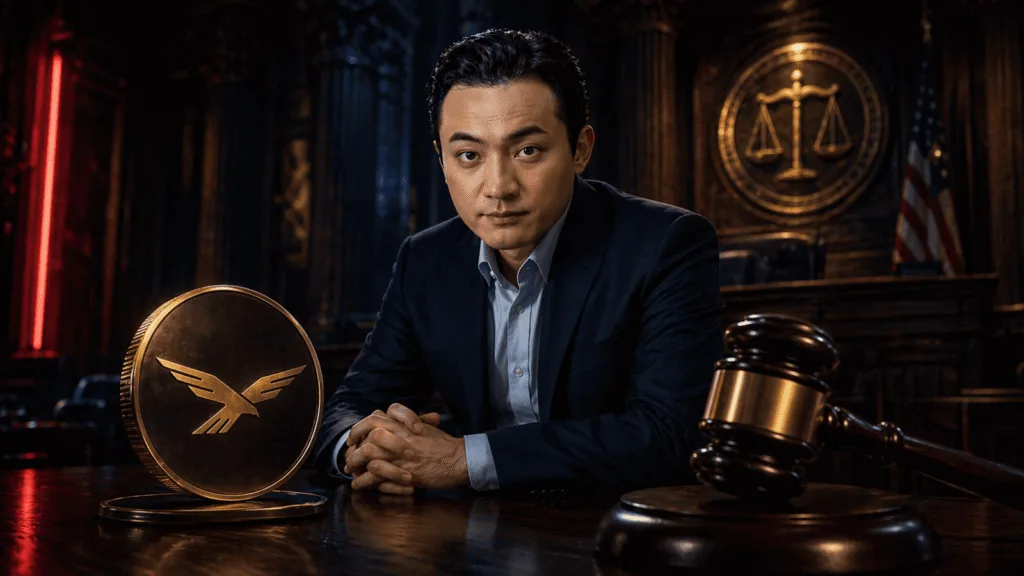



The feud between Tron founder Justin Sun and Trump-linked crypto project World Liberty Financial has officially moved from social media to a federal courtroom. Sun announced Tuesday that he filed a lawsuit against World Liberty in a California federal court, escalating what has become one of the more public and acrimonious disputes in recent crypto memory.
At the center of the case is Sun’s claim that the World Liberty team froze his WLFI tokens without justification, removed his ability to participate in governance votes, and is now threatening to permanently destroy his holdings through a process known as token burning, where tokens are sent to an irretrievable address and removed from circulation forever.
“They wrongfully froze all of my tokens, stripped me of my right to vote on governance proposals, and have threatened to permanently destroy my tokens by ‘burning’ them — all without any proper justification,” Sun said in his post on X announcing the lawsuit.

He added that he had tried to resolve the situation privately before resorting to litigation, but that World Liberty’s team had repeatedly refused to unfreeze his tokens or restore his rights as a holder. “They have left me with no choice but to turn to the courts,” he said.
From biggest backer to public critic
The timeline here matters. Sun was once the largest external investor in World Liberty Financial, the DeFi project, decentralized finance, referring to financial services that operate on blockchain networks without traditional intermediaries, that launched with visible backing from the Trump family. His falling out with the project has been quite interesting and public.
On April 12, Sun alleged that the World Liberty team had quietly embedded a blacklisting function directly into the WLFI smart contract, the self-executing code that governs how the token operates. He claimed this hidden function gave the team the unilateral ability to freeze, restrict and effectively confiscate investor tokens without disclosing the capability to buyers upfront.
World Liberty pushed back within hours. In a post on X, the project accused Sun of “playing the victim while making baseless allegations to cover up his own misconduct” and signaled it was prepared to fight back legally. “See you in court pal,” it wrote. Sun has now taken them up on that.
In his lawsuit announcement, Sun was careful to separate his grievance from any broader criticism of President Trump, whom he described as an “ardent” supporter. “I do not believe President Trump would condone these actions if he knew about them,” he wrote, pinning responsibility on what he called “certain individuals” within the World Liberty team who he says are operating the project in ways that contradict the values Trump has publicly associated with his crypto agenda.
Whether that framing is sincere or strategic, or both, is hard to say. But it’s a notable move. Criticizing a Trump-linked project while simultaneously declaring loyalty to Trump himself is a careful political tightrope for a founder who has significant business interests tied to the US crypto regulatory environment.
A governance proposal making things worse
The lawsuit arrives alongside a separate flashpoint when a governance proposal World Liberty was published on April 15 and Sun says it further penalizes token holders who don’t actively agree to its terms.
Under the proposal as Sun describes it, any token holder who does not affirmatively accept the new terms will have their tokens locked indefinitely. For early purchasers, the proposal imposes a two-year cliff, meaning no tokens become available at all for two years, followed by a two-year vesting schedule during which holdings gradually unlock.
Advisors face an additional requirement with 10 percent of their tokens to be permanently burned if they don’t accept.
The catch, from Sun’s perspective, is that his tokens are already frozen, meaning he cannot vote on the proposal at all, for or against it. He described the proposal as “bad for the community” and said the freeze has effectively silenced him at the exact moment his vote would matter most.
It’s the kind of governance structure that critics of centralized token projects have warned about for years: terms that can be changed after purchase, combined with technical mechanisms that allow the issuing team to selectively restrict specific holders. Whether a court agrees that those mechanisms are unlawful is what will now be decided in California.
World Liberty has not yet filed a formal legal response to the lawsuit. Its previous public statements have framed the freeze as a response to Sun’s own conduct, without specifying what that conduct entailed.
The case could set an interesting precedent. Disputes over token governance rights, vesting schedules and smart contract blacklisting functions are still relatively novel in US courts. If this one makes it past the initial filings, it may force a legal reckoning with questions the crypto industry has largely avoided addressing directly: what rights does a token holder actually have, and can a project unilaterally revoke them?
For now, Sun says he wants nothing more than equal treatment. “All I want is to be treated the same as every other early investor who received tokens — no better, no worse,” he wrote. That’s the kind of statement that sounds simple, but in the context of a tokenized project with opaque governance and hidden contract functions, it may turn out to be anything but.