
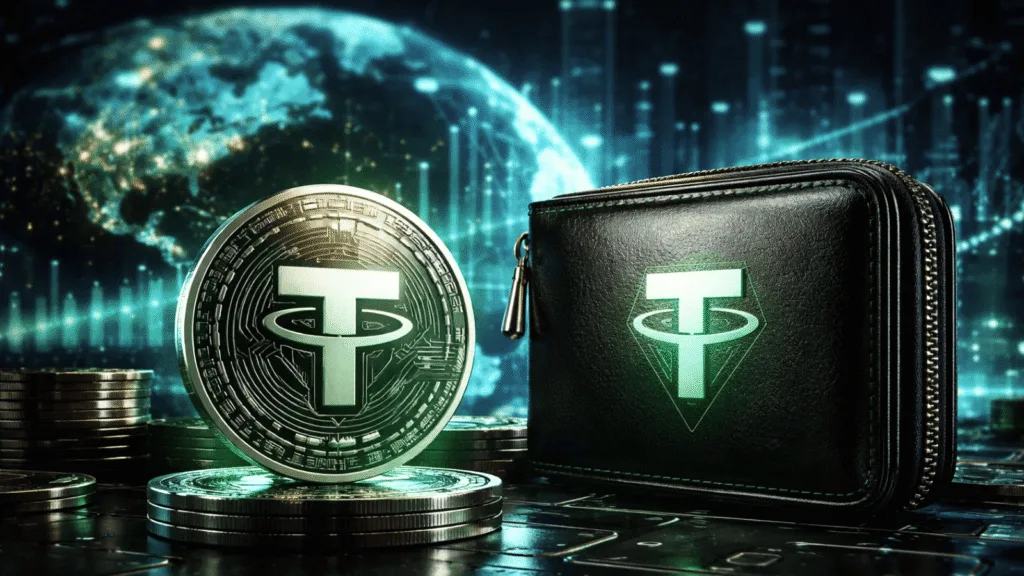



Tether, the issuer of the USDT stablecoin, has introduced its self-custodial, digital wallet on Tuesday. Dubbed the tether.wallet, the product is aimed at allowing users to store and transfer stablecoins, tokenized gold, and Bitcoin across various blockchains.
On April 14, the company launched the product as part of a larger effort to shift backend infrastructure to a direct consumer product.
The wallet accepts USDT, USAT, XAUT and Bitcoin. Tether describes the purpose of the app as simplifying crypto payments by enabling users to send money using human-readable names and pay transaction fees in the same asset they are sending.

The firm also added that private keys and recovery phrases will remain under the full control of the users on their own devices.
Tether moves closer to end users
For years, Tether has operated mainly as an infrastructure provider in the digital asset market. Its stablecoins have powered trading, settlement, and payments across exchanges and other platforms, but the company itself did not offer a mainstream wallet under its own brand.
With tether.wallet, Tether now places that infrastructure into a product that users can access directly.
The company said more than 570 million people already use its technology in some form. Tether added that this reach has grown through exchanges, payment rails, and other integrations rather than through a direct retail app.
The new wallet changes that model by giving users a front-end product linked to Tether’s payment network and asset ecosystem.
Wallet features focus on simpler transfers
Tether built the wallet around a small group of assets. At launch, the app supports USDT and XAUT on Ethereum, Polygon, Plasma, and Arbitrum.
Moreover, it also supports USAT on Ethereum and Bitcoin both on-chain and through the Lightning Network. Tether said the wallet will add more blockchains after the initial release.
The product tries to remove common pain points in crypto transactions. Users can send funds through names such as name@tether.me instead of long wallet addresses.
The wallet also lets users pay network fees with the asset they are sending, which removes the need to hold separate gas tokens. Tether said this structure can reduce user error and make transfers easier for people who are new to digital assets.
Tether Chief Executive Officer Paolo Ardoino noted that the goal is to let users send value “as easily as sending a message.” He also described tether.wallet as “the People’s Wallet,” saying it reflects Tether’s move from infrastructure provider to direct consumer service.
The company linked that message to financial access. Tether said the wallet is designed for people who have limited access to traditional banking services, especially in developing markets and high-inflation economies.
The company has long tied its stablecoin business to that goal, and the wallet gives it a product that can support that message more directly.
Self-custody remains central to the product
Tether said tether.wallet is fully self-custodial. All transactions are signed locally on the user’s device before they reach the network.
The company said private keys and recovery phrases remain under the user’s control at all times, rather than under the control of Tether or another intermediary.
That setup places the wallet within a growing part of the digital asset market that focuses on direct user ownership.
Self-custodial products have gained more attention as users seek alternatives to centralized platforms, especially for payments and peer-to-peer transfers. Tether’s entry into this area gives it a direct role in a market it has mostly served from the backend.
Furthermore, the wallet also runs on Tether’s open-source Wallet Development Kit, or WDK. The company has already used that toolkit in other projects, including integrations tied to platforms such as Rumble.
Tether said the kit supports wallets for humans, machines, and AI agents, which aligns with Ardoino’s public comments on machine-to-machine payments and self-custodial financial tools for automated systems.
The app automatically shows available balances and networks, which reduces the need for users to manage technical settings manually. This design hides much of the underlying infrastructure while keeping the wallet non-custodial.
Launch extends Tether’s broader expansion plan
The release of tether.wallet comes during a period of wider product expansion at Tether.
In recent months, the company has open-sourced its wallet toolkit, backed new payment integrations, and increased its focus on products beyond stablecoin issuance. The wallet gives that strategy a consumer-facing product with direct brand visibility.
Tether has also entered adjacent areas, including artificial intelligence infrastructure. On April 9, the company launched QVAC, an open-source software development kit aimed at decentralizing AI workloads and moving them toward user devices.
As we reported, Tether has argued that future financial activity will involve both people and AI agents, and its wallet strategy appears to support that view.
Moreover, the launch also arrives as Tether faces renewed attention on its financial reporting. The company has moved toward its first full financial statement audit, with KPMG selected for the review and PwC assisting with internal systems and reporting processes.