



Jito Foundation said on Monday that it signed a memorandum of understanding with Korea Digital Asset, or KODA, to expand institutional access to JitoSOL in South Korea.
The agreement covers institutional outreach and a review of compliant pathways for custody and staking as South Korea’s virtual asset rules continue to develop.
Jito stated that the move is part of a wider push to place JitoSOL inside Korea’s institutional market infrastructure.

The partnership centers on regulated access. Jito said KODA’s setup can support cold-wallet custody, MPC-based key management, and institutional staking for local clients.
KODA’s official site says it holds a registered VASP license, ISMS certification, and $20 million in digital asset insurance from Samsung Fire & Marine Insurance. The company also says it held 86.6 percent of Korea’s digital asset custody market by assets under custody in the second half of 2024.
KODA gives Jito a regulated local route
Jito framed KODA as a direct route into South Korea’s institutional segment. In its announcement, the foundation said KODA is Korea’s largest digital asset custody provider and a natural partner as local institutions prepare for clearer rules.
“The discussions we are having across Korea, with both asset managers and custody providers, reflect a real shift in how institutions here are approaching liquid staking as part of their digital asset allocation,” noted Jito’s Marc Liew.
In addition, KODA also linked the deal to client demand for yield products that fit regulated structures.
“Our institutional clients are increasingly focused on regulated access to staking-based returns, and JitoSOL’s profile on Solana makes it a natural starting point for those conversations,” stated Chief executive Cho Jinseok.
KODA says its platform offers secure custody, staking, access controls, and compliance features tailored for corporate and institutional users.
The companies are not launching a live product yet. They said they will work on education, client outreach, and custody and staking pathways while the local rulebook takes shape.
Jito also tied the agreement to the Financial Services Commission’s expected work on a broader digital asset framework in 2026.
Jito builds a wider institutional base around JitoSOL
The KODA deal follows another Korea-focused step from Jito in February. The foundation said it signed an MOU with Hanwha Asset Management to work on a JitoSOL-based exchange-traded product for the Korean market, subject to regulatory approval.
Jito described that move as part of a plan to expand institutional access to Solana-linked products through regulated wrappers.
Jito has also added an institutional product in Europe. On January 28, the foundation announced the 21Shares Jito Staked SOL ETP, which it described as the first European exchange-traded product backed fully by JitoSOL.
The product trades on Euronext Amsterdam and Paris and gives regulated market access to Solana exposure plus staking and MEV rewards.
Moreover, those launches show a pattern in Jito’s recent strategy. The foundation is not limiting JitoSOL to crypto-native users. It is working with custodians, asset managers, and exchange-traded product issuers to place liquid staking inside structures that institutions already use.
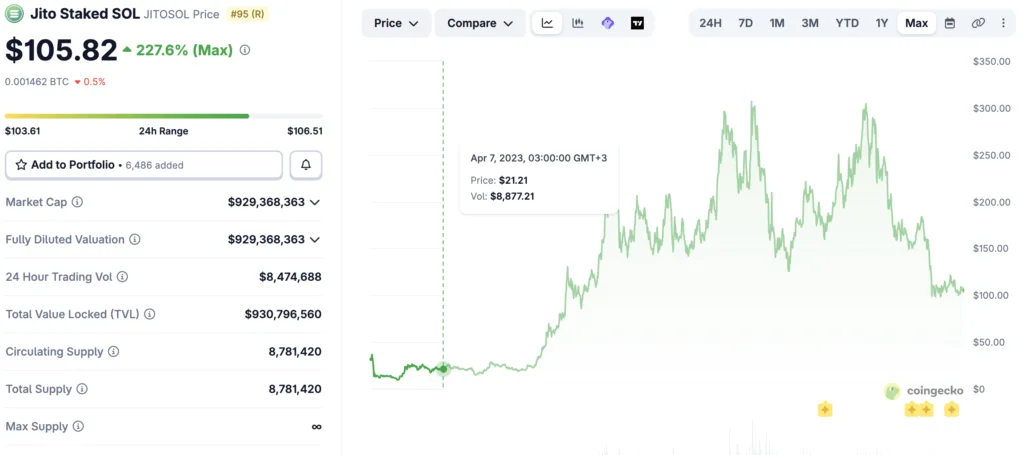
In Monday’s post, Jito said global custodians such as BitGo and Hex Trust also support JitoSOL from custody accounts. JitoSOL had a market capitalization of about $930 million at the time of writing (based on CoinGecko’s data).
South Korea tightens crypto oversight as institutions prepare
The South Korean regulatory setting adds more context to the KODA partnership. On April 6, the Financial Services Commission said domestic virtual asset exchanges will need real-time ledger-to-wallet balance reconciliation every five minutes after inspections following Bithumb’s payout error.
The FSC also said exchanges will need stronger internal controls and clearer kill-switch standards.
The FSC moved again on March 30 with proposed rule changes aimed at stronger VASP registration and anti-money laundering duties.
The proposal would require crypto exchanges to adopt vishing prevention and damage relief measures similar to those used by financial companies. The commission said the changes were meant to close loopholes and strengthen market entry and AML rules.
Market surveillance is also getting tighter. A report published Monday said South Korea’s Financial Supervisory Service will investigate suspicious API-driven trading after automated tools accounted for more than 30% of crypto buy and sell orders in the country.
That report came days after new controls on withdrawal-delay exemptions linked to fraud losses. Together, those steps show that South Korea is moving toward a stricter market framework even as firms like Jito and KODA position for institutional growth.