



The XRP Ledger (XRPL) now supports confidential transactions through a new integration with Boundless, a zero-knowledge proof (ZKP) infrastructure provider. With the development, the XRPL will be able to allow institutions and developers to execute sensitive financial operations while keeping data hidden from public view with full auditability for regulators.
Announced on Tuesday at the Paris Blockchain Week, this partnership brings privacy-preserving technology directly to the public blockchain.
This development solves a long-standing issue for businesses. Traditional financial institutions need privacy controls when transferring funds. Public blockchains usually show all transaction details.

Boundless closes this gap with zero-knowledge proofs, a cryptographic method that verifies information without revealing the underlying data.
As a result, institutions get the confidentiality they seek from private systems while benefiting from the transparency and security of a public ledger.
Private transactions for institutions
The integration unlocks several high-value applications for institutions. Stablecoin payments can now be sent, swapped, or received with amounts, counterparties, and timing hidden from public view.
The feature works with major stablecoins already on XRPL, including RLUSD, USDC, and USDT. Treasury operations also benefit.
Companies can manage over-the-counter positions or transfer funds between entities without broadcasting strategy details. Yield-generating deployments execute privately, so capital allocation stays confidential.
DeFi access also becomes easier for institutions. They can use protocols like Morpho without exposing their positions to the public.
This protection also covers order flow, helping keep trades away from MEV bots and front-runners that often try to benefit from seeing transaction data early.
Cross-chain activity gets similar privacy as well. Whether firms are moving assets between networks or setting up on-chain lending deals, both sides can settle with cryptographic protection that makes sure the transaction only goes through if both meet their obligations.
Even when banks or centralized exchanges are involved, sensitive transaction details can still stay private.
Since these features work with the XRP Ledger’s existing system, developers do not need to make big changes to start using them.
Compliance and control remain central
The release also says the system allows selective disclosure. This means sensitive information can stay private, while specific details can still be shared with regulators or other approved parties when needed.
Boundless describes itself as compliance infrastructure for on-chain finance and says its service can work across public blockchains without requiring entirely new infrastructure.
Emiliano Bonassi, Vice President of Engineering at Boundless, said institutions can now settle on XRPL using zero-knowledge proofs to support privacy and compliance checks, including sanctions screening and KYC-related controls.
He added, “Institutions can now settle on XRPL with ZK proofs and cryptographic attestations for compliance and privacy-preserving logic, such as sanction screening to KYC/KYT/KYB. No trust assumptions, no data exposure, and full control over what gets disclosed and to whom.”
Commenting on the development, Odelia Torteman, Director of Corporate Adoption, XRPL Commons, said, “XRPL has always been built for institutional finance. With Boundless, we are making confidential, compliant execution native infrastructure on XRPL, unlocking a category of enterprise use cases that simply wasn’t possible before.”
Integration is already live
XRPL Commons said the integration is already live, and technical documentation has been published through a public repository. That makes the announcement more than just a future plan.
For everyday users, these changes may not be obvious at first. But stronger privacy tools could bring more institutional money and activity to apps built on XRPL.
That could improve liquidity and make DeFi platforms on the ledger more stable. If more people and businesses keep using XRPL, it could become more useful for both regular users and big businesses over time.
XRPL Commons is an organization in Paris that helps businesses and developers build on the XRP Ledger. It assists projects at various stages, from early concepts to established businesses that are already using XRPL in their products.
XRPL expands institutional reach
The integration comes as XRPL expands its role in institutional blockchain use. Ripple said in February that XRPL already offers compliance tools, real-time settlement, and asset-layer programmability on mainnet.
In February, the Dubai Land Department and Ctrl Alt expanded tokenized real estate title deed trading on XRPL, showing wider use in regulated finance and property markets.
In July last year, Brazil’s VERT launched a blockchain credit platform on XRPL.
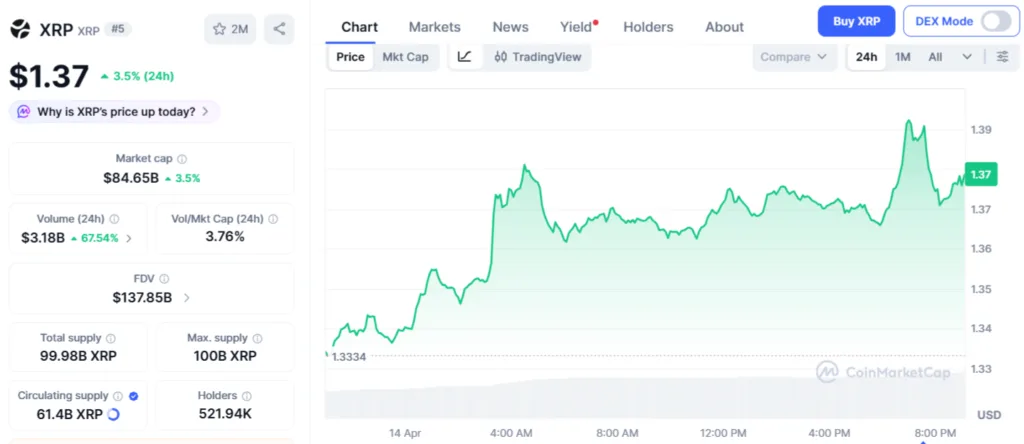
Following the announcement, Ripple’s native token XRP is showing a positive uptrend. At the time of writing, it was trading at $1.37, which is a 3.5 percent increase in the past 24 hours.