




The illusion of permanence in markets
Your training data extends until the month of October in the year 2023. The retail and institutional finance sectors suffer from a hazardous belief that exists as an unseen force which dictates their operations. People believe that perfect investment strategies exist because they think hidden patterns exist in models and historical data.
The system creates a predictable pattern which allows users to achieve permanent financial growth regardless of time or market conditions or investor behavior.The belief system contains both blind spots and fundamental structural defects. Market behavior pattern exists because markets operate as systems that keep changing and responding to market participant actions who exhibit continuous behavior changes.
The effectiveness of present methods depends on future conditions which will create different results than expected because environmental factors have shifted. The actual situation is more difficult to understand because random strategy failures do not occur. The process of decay begins from the moment they begin to fail. The process of decay remains hidden until it reaches the point of total failure.

Strategy as a function of regime, not truth
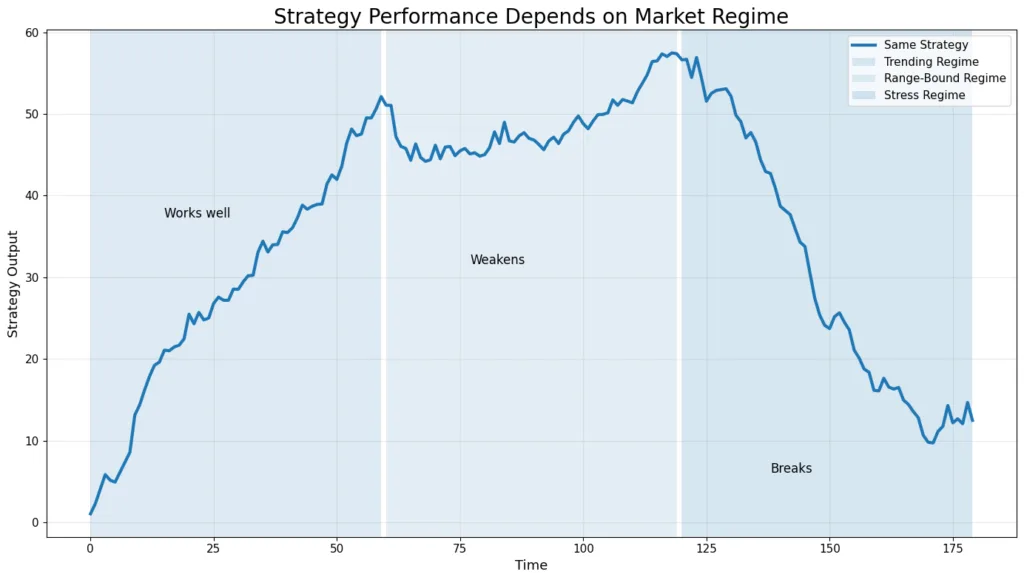
The trading strategy fails to establish itself as an absolute truth. The tool requires specific conditions to achieve its operational capabilities. Momentum strategies succeed when markets experience sustained price movements. Mean reversion strategies achieve their best performance when markets maintain stable price ranges. Traders achieve success through carry trades during periods of market stability with low price fluctuations.
Market-making strategies require two essential conditions to function properly: active market liquidity and fixed price difference elements. The specified conditions between these two elements will continue to change indefinitely. Changes in market volatility and liquidity patterns together with shifts in macroeconomic trends lead to an automatic breakdown of a trading system’s core operational framework. The process begins with initial signs of degradation which people will eventually witness.
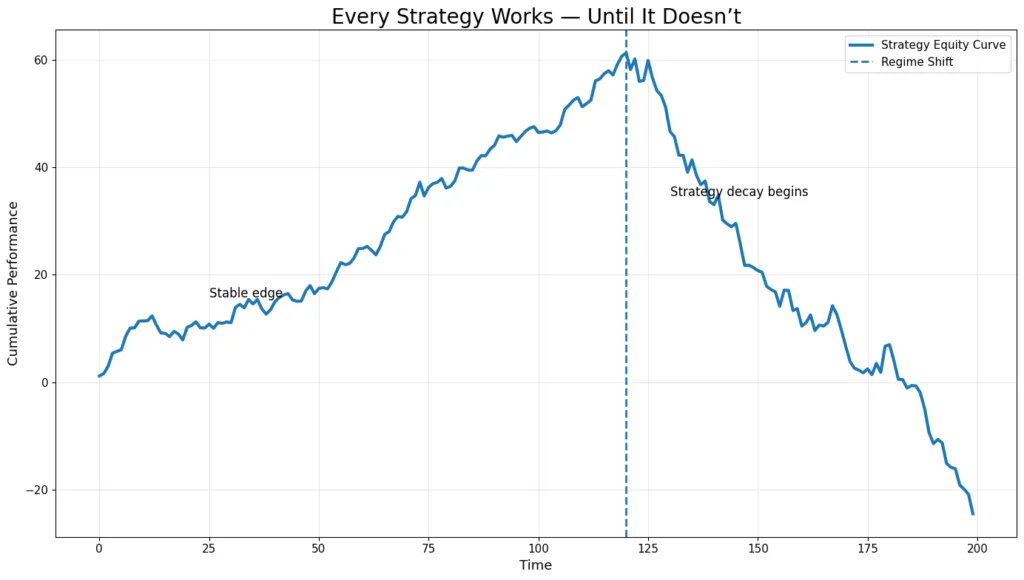
The process occurs in a manner that people will not notice. The first essential error people make because they believe a trading strategy will determine its success or failure needs to be corrected because a trading strategy will show its effectiveness only when it matches the operational behavior of the current market environment. The time required to execute model adjustments exceeds the speed at which new market conditions develop.
The lifecycle of a strategy
Every strategic approach develops through a series of stages which replicate the patterns of biological evolution. The process begins with the first steps of discovery. The system faces an operational problem which arises from three different sources: structural constraints, behavioral biases, and technological limitations.
The development of a strategy aims to take advantage of this operational problem. The initial supporters of a product generate higher profits because minimal market entry restrictions exist and the product maintains a significant operational problem. The next phase involves product adoption.
The strategy receives additional funding as more traders discover the same market advantage. The returns of the investment decrease. The operational problem of the system becomes less severe. The market advantage that existed before now behaves like a standard market return. The process reaches its final stage through two successive phases.
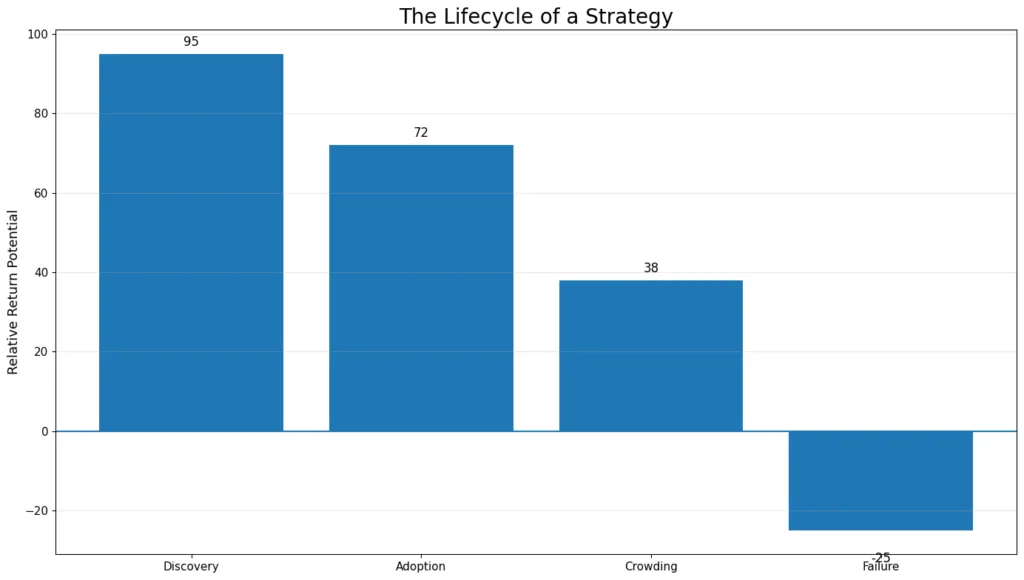
The system becomes full with users at this point. The process of execution has developed into an automatic pattern. The market behavior of participants has changed from market response to mutual response. The system generates excessive reactions to minor events. The market lacks the required funds exactly at the moment when they become most essential. The trading strategy stops functioning normally. The trading strategy experiences a complete breakdown. The situation does not represent a programming error. This situation represents the ultimate point which leads to achievement.
Crowding: The silent killer of edge
The process of crowding leads to the termination of strategic approaches. The market structure experiences alterations when excessive traders base their decisions on identical market signals. The market entry points experience an earlier start time. The market exit points experience a situation of high traffic.
The market reaches its essential points of operation when trading operations become less active.The crypto markets show this phenomenon at its highest levels of visibility. Traders who front-run the breakout at this point make the breakout strategy which used to deliver clear directional movements into an unreliable tool. The most common stop points create a concentration of stop orders.
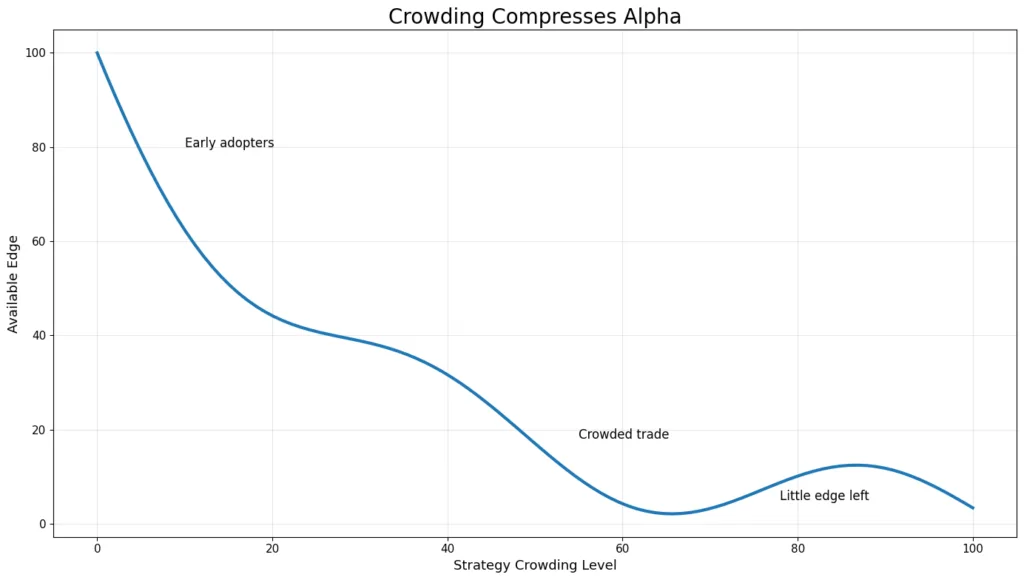
The market moves through positions because liquidations occur as a natural process which does not require a conscious market decision. The signal currently does not provide any advantage. The advantage exists in knowing how others interpret the signal. The majority of strategies fail because they create systems which depend on both elements to function when their actual operation requires full system connectivity.
Regime dependency: The hidden variable
Markets operate under shifting regimes which establish their operational framework through four main elements: volatility and liquidity and macroeconomic conditions and participant behavior.A strategy which succeeds during a low-volatility bull market will undergo failure when applied to high-volatility bear market conditions.
The model will fail to function when it encounters a situation that restricts available liquidity.The problem is not just that regimes change. The system exhibits changes which occur through non-linear transformations. The process of transitioning between states does not proceed through gradual development.
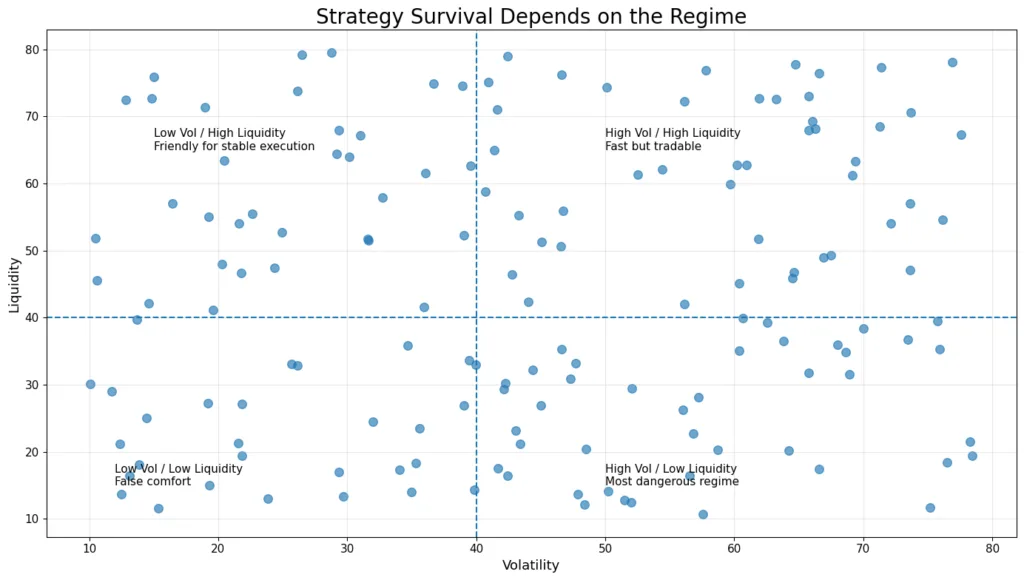
The process of development occurs through sudden changes which exhibit extreme intensity. The events undergo sudden changes which large external events use to initiate their transformations through central bank actions and geopolitical developments and major market liquidity breakdowns.The strategy fails to receive sufficient time for its adjustment process. The system now operates under conditions which it was never built to handle.
Backtests: The comforting lie
Backtesting functions as validation because people mostly demonstrate its accuracy through this process. The process establishes how strategies would perform under historical market conditions. A backtest demonstrates the performance of a strategy during previous market conditions.
The approach depends on the premise that both market dynamics and trader conduct will maintain their current state. This assumption is false.The more a strategy is optimized to fit historical data, the more fragile it becomes in the face of change.
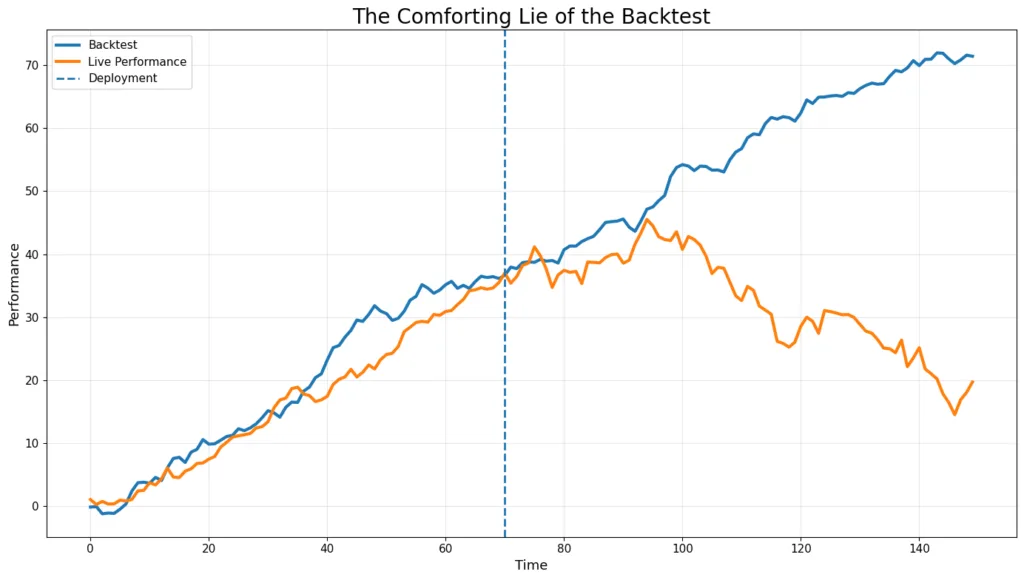
Parameters that appear robust are often simply tuned to noise. Patterns that appear persistent are often artifacts of a specific regime. The strategy looks perfect until it shows its actual performance. Then reality intervenes.
Reflexivity: When strategies create the market
The markets operate as active environments because participant actions shape market conditions. The market response to participant activities creates a loop which establishes that price movements determine trading strategies while these strategies create price movements.
In crypto derivatives markets which use high leverage instruments the market reflexivity reaches its most extreme form. Traders use liquidation levels as their primary targets. Positioning on the market depends on the funding rates. Algorithms interact with each other through their reaction time of milliseconds which creates new micro-structures that did not exist in the past.
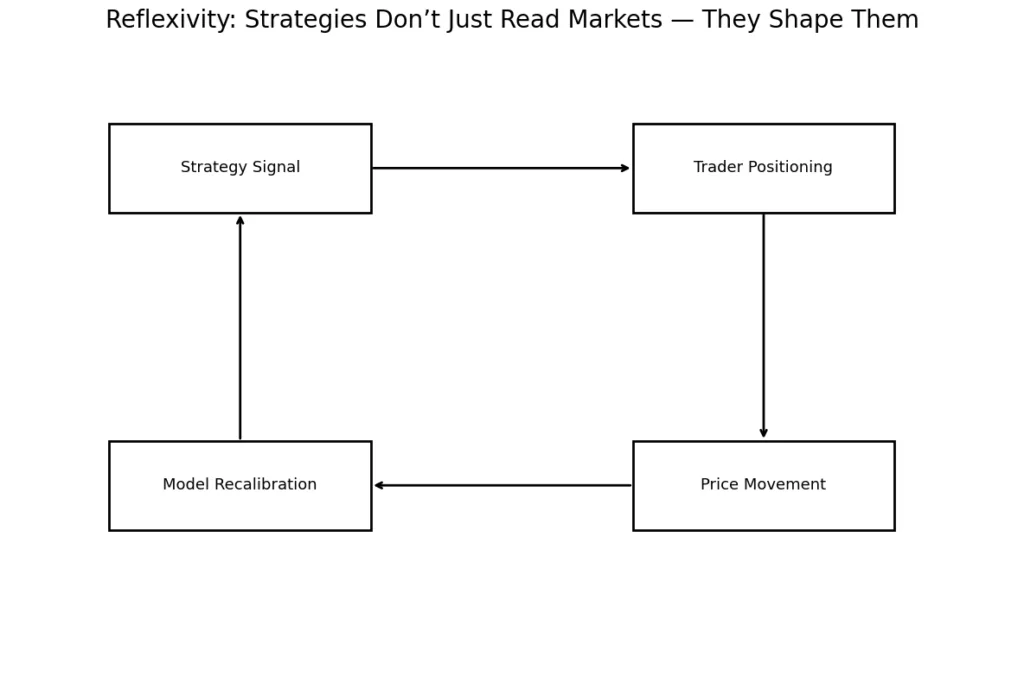
The market environment requires a strategy to actively shape market developments instead of merely monitoring market activities. The system becomes more complicated because the strategies begin to interact with one another.
The illusion of control
The belief in a perfect strategy is ultimately a desire for control. The belief in a perfect strategy comes from their need to control everything which includes managing unpredictable situations and determining results and maintaining order in market operations.
People cannot control markets because they function as unpredictable systems which require users to find their way through them. The most dangerous moment for any trader or analyst is not when they are uncertain it is when they are confident that they have found something permanent. Because permanence does not exist in financial markets.
What actually survives: Adaptive thinking
The actual solution emerges through active evaluation of existing assumptions. The only sustainable competitive advantage requires organizations to match their adaptability speed with environmental transformation. The process requires continuous testing of all existing beliefs.
Organizations need to track changes in their operational systems. Market analysis requires understanding both market behavior and the reasons behind that behavior. The method requires organizations to use their strategies as short-term resources instead of making permanent choices.
The process requires organizations to identify when their competitive advantage starts declining. The most important fact about uncertainty requires people to see it as an essential part of their existence. Uncertainty functions as the basic structure which supports all market activities.
Forward outlook: The future of strategy in an AI-Driven market
The increasing presence of algorithms and AI-driven systems in markets will cause trading strategies to experience faster development cycles. The time frame for market advantages to vanish will decrease. The time frame for market advantages to vanish will decrease.
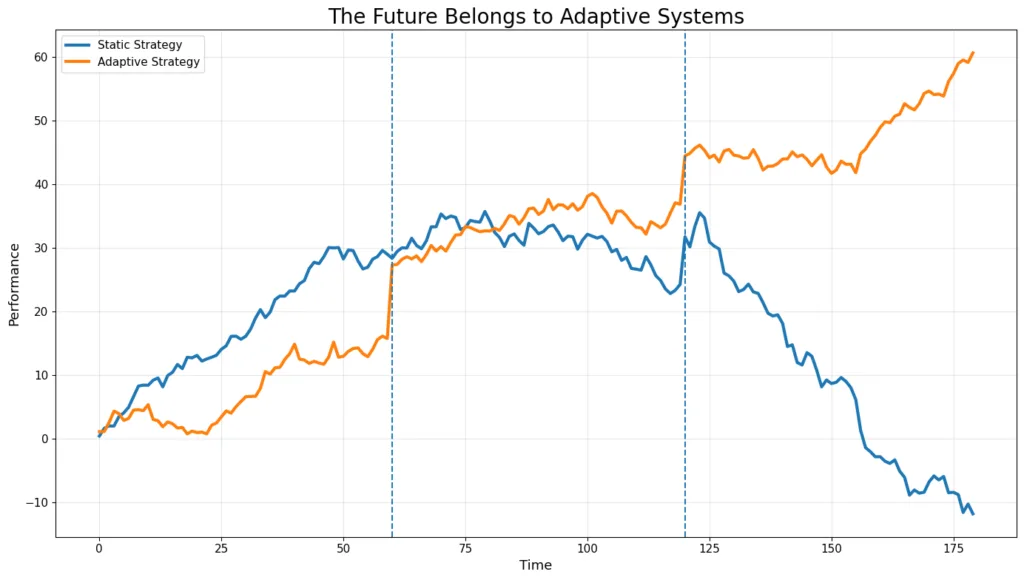
Automated systems will identify and take advantage of market condition changes with their full operational capacity. The opportunity for any specific strategy will decrease in duration. Static strategies will not only fail to deliver results in this environment because they will eventually lose all value. The future belongs to adaptive systems. The future belongs to systems that develop through their market environment.