




Crypto failures occur through their silent process which leads to sudden complete breakdown. Financial institutions developed risk assessment systems during multiple decades which focused on measuring market risks through three primary factors.
The financial markets required predictable statistical limits because their models operated under conditions of normal market behavior and showed predictable patterns when liquidity faced pressure and extreme events occurred as unpredicted events.
Crypto does not exist within that particular economic framework. An asset class behaves like a living system which adapts through reflexive processes while becoming unstable under growing force. The system creates an illusion which shows that risk can be exactly measured through every moment because the system continuously updates its operational boundaries.

The illusion of sigma when statistics become a comfort narrative
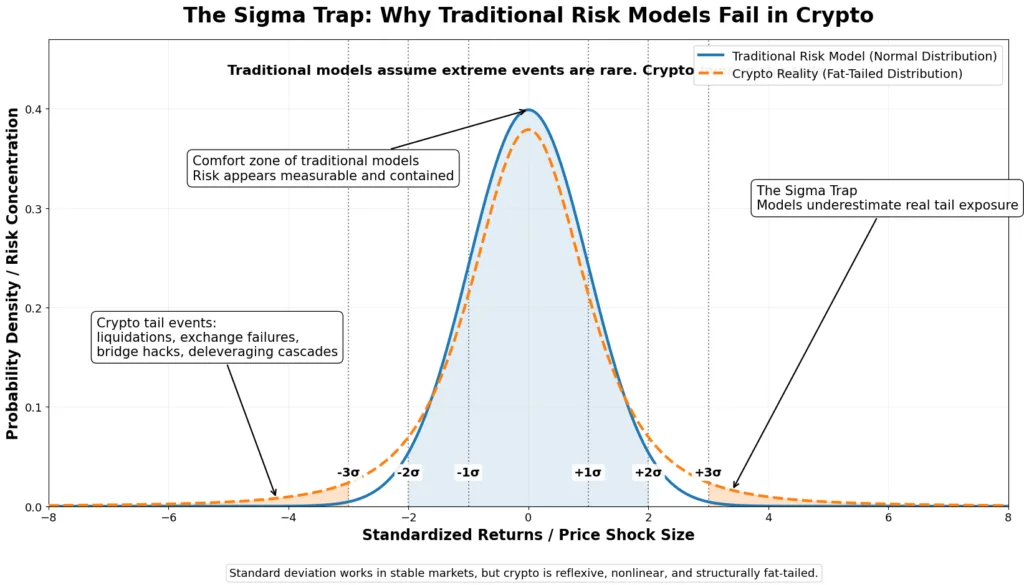
The concept of standard deviation serves as the fundamental measure of traditional risk because it establishes a system where market movements exist between two fixed points. In that world, extreme events are confined to the edges of a probability curve, and risk becomes something that can be bounded, measured, and controlled.Crypto does not respect these boundaries. Price behavior consistently violates the assumptions of normality. What would be considered a multi-standard deviation event in equities becomes routine in digital assets.
The system experiences large dislocations as permanent elements which exist in the system’s design. The distribution shows neither smoothness nor predictable behavior. The distribution exhibits heavy-tailed characteristics together with skewness and path-dependent sensitivity.
The actual results exceed expected results because they depend on the order of previous occurrences. Sigma, in this environment, does not capture risk. The system creates a deceptive appearance of mathematical stability which enables risk to remain hidden.
When price becomes the source of risk
The financial system operates under the belief that price changes result from new information. The sequence starts with news delivery followed by market response until they reach their balanced state.
Crypto reverses this established connection between two variables. Market participants react to new information which emerges from price movements that bring about their initial price change.A price decrease during market trading shows more than market emotions.
The process begins with a single event. The market faces a downturn because leveraged positions start to close and liquidation engines begin their work and forced selling creates more downward pressure. The financial system faces instability because liquidity providers stop their activities while market spreads increase during times of high volatility. The feedback system develops price as a factor which generates worldwide financial dangers. The system creates its own dangers because it uses internal mechanisms to maintain its operations.
The leverage architecture
The crypto market allows users to use leverage across all its different components. Leverage exists across all market types which include centralized exchanges and decentralized protocols and derivatives markets and synthetic instruments. The process of exposure duplication through rehypothecation creates hidden risks which operate across multiple platforms that lack a common risk management system.
The system establishes a framework which enables small price fluctuations to produce exceptionally high results. The system operates according to a non-linear pattern. The market decline leads to extensive liquidations because the initial price drop lacked significance but the existing leverage magnified its results.
The traditional models for price and risk relationships assume that all connections between these two variables will move in a straight line. The crypto market system disproves this particular assumption. The relationship between two variables displays a convex pattern which indicates that risk increases at a faster rate than price fluctuations do particularly in times of market stress.
Liquidity as a conditional state
Traders in traditional markets see liquidity as an unchanging factor that persists through all market conditions. The crypto market has two different liquidity conditions. The market operates with liquidity until traders choose to stop providing it which leads to its immediate disappearance.
Market participants who have temporary access to deep order books will experience order book disappearance within a few seconds. Market makers need to reduce their capital exposure because they face increased danger. This situation leads to execution problems while slippage rates increase and price discovery stops functioning.
Traditional risk models contain a fundamental weakness that becomes visible through this vulnerable system. The system assumes that traders can modify their existing positions at any moment. Traders in the crypto market face uncertainty when they want to close their positions. The ability of traders to exit their positions depends on market liquidity which requires traders to have trust in the market.
The collapse of diversification
The process of asset diversification depends on the fundamental belief that different assets will react differently during market stress events. The combination of assets that show no correlation with each other results in a decrease of overall investment risk. The fundamental assumption of crypto markets fails during the most critical periods of operation.
Market stress periods cause asset relationships to become more interconnected. Initially separate assets begin to operate together as one entity. Bitcoin prices decrease while other assets experience even stronger declines. Stablecoins which people consider stable financial instruments can experience depegging events.
The strategies which investors use to protect their investments will not work because all their assets will be affected by the same market condition which requires them to sell their holdings. The correlation between cryptocurrencies shows unstable behavior. The system exhibits behavior changes based on its current state. The normal operational state of the system shows successful results from diversification methods. The system experiences complete failure during stress events.
A system that manufactures extremes
The cryptocurrency market undergoes more than just extreme market fluctuations. The market creates its own extreme market events. The system design creates many vulnerabilities because it contains both smart contract weaknesses and oracle systems and cross-chain bridge connections. The system becomes more delicate because every single element that exists in it creates additional complexity. The system will experience problems because any system failure will spread through all parts of the network.
A protocol exploit creates conditions that lead to a liquidity crisis. An exchange insolvency creates conditions that result in widespread market panic. Regulatory interventions create immediate changes that completely transform the marketplace. The system experiences these events as normal operations because it develops at a speed that exceeds the ability of its protective measures to keep up.
The traditional models of extreme events predict that these events only happen in exceptional situations. The crypto market experiences extreme events which occur repeatedly and connect with each other.
Time compression the speed of collapse
The risk in traditional markets develops through long periods which provide opportunities for both assessment and decision-making and market adjustments. The crypto market experiences time compression. The market operates at all times because it lacks both trading hour restrictions and centralized control. Liquidation cascades can occur within a time frame of only minutes.
The system shuts down trading positions through automatic processes which require no human involvement. The market has already surpassed the predictive limits of risk models by the time their input data receives updates. Traditional methods become useless because of this mismatch in timing. The process of risk measurement contains two problems which include mismeasurement of risk and the faster evolution of risks than models can forecast.
The sigma trap defined
The Sigma Trap arises because there exists incorrect mapping between actual conditions and model predictions. The belief exists that risk can be reduced to statistical parameters because the system does not permit such simplification. The system displays three false assumptions which include its belief in stability its assumption of linear behavior and its view of independence across interconnected parts. The system generates precise numerical results which fail to represent the actual processes that produce extreme results. The participants use these models for risk management when they actually create an underestimation of risk.
Toward a new framework
People need to use structural analysis instead of probability-based methods to evaluate risk in cryptocurrency markets. The focus must move from what is likely to what is possible.This requirement includes three elements which need to be understood: how events progress through time to create results and how liquidity needs to be analyzed instead of being taken as a given and how all system components need their leverage to be tracked throughout the entire network.
It requires an understanding of reflexivity which describes how price changes affect system stability and the ability to evaluate situations that go beyond standard predictions. Uncertainty remains present even after implementing the approach. The system treats uncertainty as its fundamental element.