
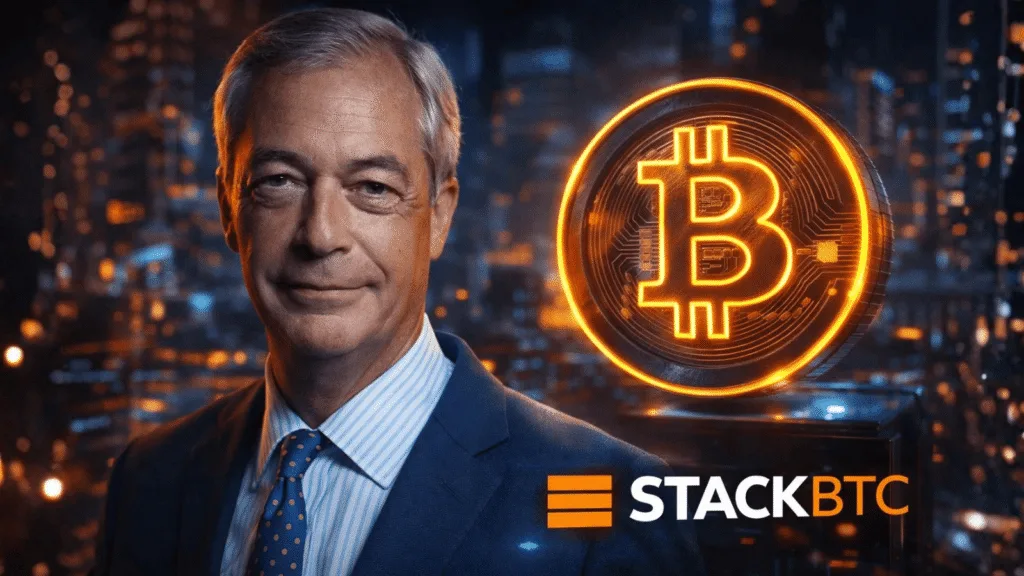



UK-based politician Nigel Farage is again facing trouble because of his connections with the crypto industry after being accused of having to be probed for his dealings with the crypto asset company Stack BTC. The trouble follows worries about the possible conflicts of interest associated with Farage’s dealings in the crypto space.
The regulatory probe comes after Stack BTC company, whose board includes former UK Chancellor Kwasi Kwarteng as chairman, decided to acquire 37 Bitcoins, whose market value is estimated to be around $2.7 million.
The company stated that they did this as part of their treasury strategy to bolster their finances through increased investments in digital assets. Stack BTC currently holds 68 Bitcoins with an average price of $72,400 per coin.

Not long after this news was released, Farage found himself involved in promotional materials from the company, saying that companies who implement Bitcoin treasury strategies will have to own them.
Democrats raise question on Farage’s involvement
The Liberal Democrats have sent a letter to the FCA urging the body to investigate whether there was any violation of market conduct regulations in Farage’s conduct. There are concerns whether the politician’s endorsement of Stack BTC, who was at the same time making financial gains from the company, could be interpreted as a conflict of interest or market abuse.
Based on disclosure information, Farage increased his financial exposure to the cryptocurrency space by investing $286,000 in Stack BTC through his media firm, Thorn In The Side, which made him a shareholder with a 6.31 percent equity.
It would seem that being both an investor in the cryptocurrency and a well-known political figure may be a case of a conflict of interest since it can influence market conduct indirectly.
Daisy Cooper, the deputy leader of the Liberal Democrats, posited that the matter goes beyond a personal decision but is more concerned with market conduct.
She noted that since Farage has been advocating for cryptocurrencies in his political life, it can be said that his message might be indirectly influencing the market perception and positively impacting his personal gain as an investor.
She further cautioned that this situation underscores a wider regulatory vulnerability. It reveals how political power and nascent financial markets, such as cryptocurrency, can converge without adequate protective measures in place.
Scrutiny in tandem with UK’s crypto donation ban
The regulatory watch is taking place amid a crackdown on the use of cryptocurrencies by political candidates in the UK. The move to regulate the use of cryptocurrencies in making political donations in the UK reflects the wider trend where regulatory bodies are reacting to the increasing adoption of cryptocurrencies in society. Parliamentarians are concerned that the global reach and intricate ownership of cryptocurrencies might allow for concealed influences within a nation’s political sphere.
To address these concerns, the proposed regulation seeks to temporarily prohibit political party donations made using cryptocurrencies. According to authorities, in contrast to cash flows from banking institutions, cryptocurrency transactions could prove challenging to trace in real time because they could be carried out through intermediaries operating in several different jurisdictions.
Interim regulations have received backing from the Prime Minister of the United Kingdom, Keir Starmer.
Policymakers are not seeking to stall the development of digital currency but rather ensure that laws concerning political finance keep up with innovation.
In addition, the temporary ban on cryptocurrency donations to political campaigns is also viewed in light of broader efforts to restore trust in transparent funding of political activities. The issue of potential political abuse has been on the agenda for the last few years due to the increasing popularity of donations from large corporations, whose origins, in some cases related to emerging fields such as crypto assets, may not always be known.
There is also concern regarding the reputational aspect of the problem since cryptocurrencies’ growing popularity could make people question the neutrality of political campaigns that accept donations in cryptos and potentially link their success or failures to certain events in the crypto markets.
It is important to note, however, that there is no consensus in terms of whether or not there is a need for additional regulations. Supporters of the crypto technology believe that crypto assets represent merely a different way of making a financial contribution that should be regulated similarly to other funding sources.
Interim restrictions indicate that the UK has been adopting a cautious yet decisive approach towards regulating its financial sector. Instead of imposing a final decision on a total ban, the UK government seems to be opting for a more transitional process in evaluating how to control its ever-changing financial system.
Given the increasing debate regarding the role of crypto-related people and firms in terms of political scrutiny, this approach by the UK government can lead to even greater discussion on how far financial involvement should extend before it crosses over into political manipulation.
On the other hand, Reform UK – a political party led by Nigel Farage – has itself been facing criticism due to its strong financial support from crypto-related individuals, such as a £9 million donation to the party by Christopher Harborne, an early crypto investor.
Does crypto have hidden political influence?
Proponents of tighter regulations claim that cryptocurrencies’ volatility and anonymity make it impossible to trace the origins of political financing completely, thus facilitating the process of covert manipulation of the democratic electoral process. Moreover, they refer to the rise of “Bitcoin treasury companies” such as Stack BTC as one of the latest frontiers in which promotion of finance and political discourse can merge.
Additionally, Farage is also widely recognized for his cryptocurrency-friendly stance, constantly stressing the significance of innovations and personal financial freedom, and consequently, favoring more liberal legislation concerning cryptocurrencies.
The members of his political team consider Farage’s engagement with the industry as an expression of his economic beliefs, rather than any sort of misconduct.
Nonetheless, critics believe that political advocacy and financial participation in the context of cryptocurrency trading lead to conflicts of interest, or even to violations of financial market conduct regulations.
It remains unclear whether the Financial Conduct Authority will launch an investigation regarding this case. Nevertheless, this controversy raises significant concerns regarding the relationship between politicians and cryptocurrency trading.
As digital assets become more embedded in mainstream finance and politics, cases like this are likely to set important precedents for how transparency and conflict-of-interest rules are applied in the crypto era.