
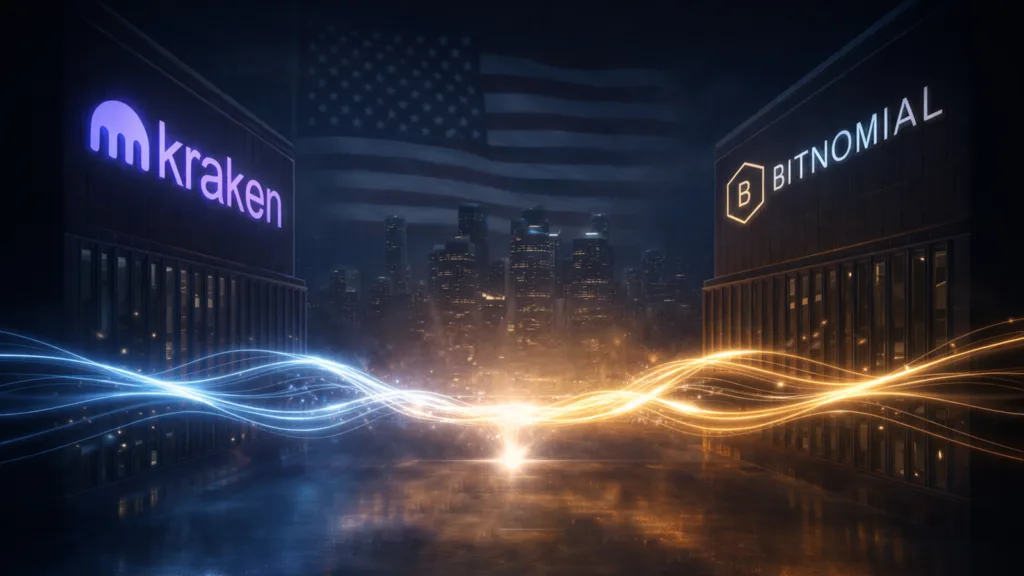



Payward, the parent company of crypto exchange Kraken, has agreed to acquire derivatives exchange Bitnomial for up to $550 million in cash and stock, according to details shared on April 17.
The acquisition provides Payward with a fully licensed U.S. crypto derivatives platform as the company grows its regulated market business.
Meanwhile, the deal includes 100 percent of the equity of Bitnomial and will close within the first half of 2026, subject to standard terms and regulatory filing.

Payward claimed that the action will enhance its standing in the U.S. by uniting a brokerage, a clearing house, and an exchange to a single framework.
Bitnomial adds a full licensed derivatives stack
Bitnomial gives Payward access to three licenses needed to run a domestic full-stack derivatives business. The platform holds approvals to operate a designated contract market, a derivatives clearing organization, and a futures commission merchant.
That structure places Bitnomial among the few crypto-native firms with a complete regulated derivatives setup in the United States.
Importantly, the acquisition gives Payward a faster path into the U.S. derivatives market. Building the same structure from the ground up would likely take years, especially in a market where firms continue to face close regulatory review.
By buying Bitnomial, Payward gains licensed infrastructure that is already in place and ready to support broader product expansion.
Payward Co-CEO Arjun Sethi framed the strategy around market structure and back-end operations.
“The shape of a market is determined by its clearing infrastructure, not its front end,” he stated.
He also pointed to Bitnomial’s crypto-native settlement model, collateral system, and round-the-clock trading capabilities as core parts of the deal.
Moreover, that comment reflects Payward’s focus on the operating layer behind trading activity. Rather than focusing only on user-facing platforms, the company is adding the systems that support clearing, settlement, and regulated product delivery in the U.S. market.
Kraken builds toward a broader market model
The Bitnomial transaction is part of a broader Kraken and Payward strategy. In recent years, the group has used acquisitions to expand beyond spot crypto trading and build a broader multi-asset platform.
The firm has concentrated on the incorporation of trading infrastructure, licenses and regulated access points as opposed to the mere organic expansion.
Its largest move came in 2025 with the $1.5 billion acquisition of NinjaTrader, a U.S.-based retail futures platform and CFTC-registered futures commission merchant. That deal gave Kraken a direct position in U.S. futures markets and access to an established retail trader base.
Earlier purchases, including BCM in 2023 and Small Exchange, also supported its institutional and derivatives business.
Payward now plans to connect Bitnomial’s infrastructure with its existing brands, including Kraken and NinjaTrader. The company said the combined platform will use Bitnomial’s regulated U.S. setup together with Payward’s liquidity and distribution network.
The company’s business-to-business arm, Payward Services, also stands to grow from the deal. Payward said banks, fintech firms, and brokerages will be able to access regulated U.S. derivatives products through a single API connection. That adds another route for the company to offer infrastructure services beyond direct exchange activity.
Derivatives products move closer to U.S. launch
Payward said the combined platform is expected to offer spot margin, perpetual futures, and options to U.S. clients under Commodity Futures Trading Commission (CFTC) oversight.
Those products would expand Kraken’s U.S. product lineup at a time when regulated derivatives remain a key area of competition across the sector.
Moreover, the company has already built out its derivatives business outside the United States. It acquired a U.K. crypto futures platform in 2019 and launched a European Union offering in 2025. With Bitnomial, Payward adds the missing U.S. layer to a business it has been building across several jurisdictions.
Kraken has also expanded into structured products through a partnership with STS Digital. On March 25, the exchange launched Dual Investment through STS Digital’s platform, giving eligible users another way to seek returns on Bitcoin and Ether.
That rollout added to a broader industry push to package options-based strategies into simpler formats for institutions and selected retail users.
Separate reports have also linked Kraken to work involving tokenized stocks with Nasdaq. Those efforts aim to allow tokenized equities to move between regulated venues and on-chain marketplaces while keeping issuer rights intact.
Deal activity rises as IPO plans remain in focus
The Bitnomial acquisition comes as crypto deal activity starts to recover after a long slowdown. Larger firms have increasingly targeted businesses that offer licenses, custody tools, derivatives systems, or compliance capabilities.
At the same time, lower valuations and tighter funding conditions have made acquisitions more attractive for buyers and more practical for smaller firms.
Payward has also been scaling its business ahead of a possible public listing. The company said it confidentially submitted a draft S-1 to the U.S. Securities and Exchange Commission on November 19 last year.
Later reports said the firm had paused its IPO plans due to market conditions, though it has not ruled out a listing when conditions improve.
On April 15, Kraken signaled that its IPO path remained active despite reports of a delay. Sethi’s recent comments suggested the company still plans to follow its current strategy even during a volatile market period.
In addition, that message came just days after reports that Deutsche Börse Group had made a $200 million investment in Payward.
Recent developments have also added to Kraken’s position as it moves closer to regulated financial market infrastructure. On March 4, Kraken became the first crypto exchange to gain access to the U.S. Federal Reserve payment network.