
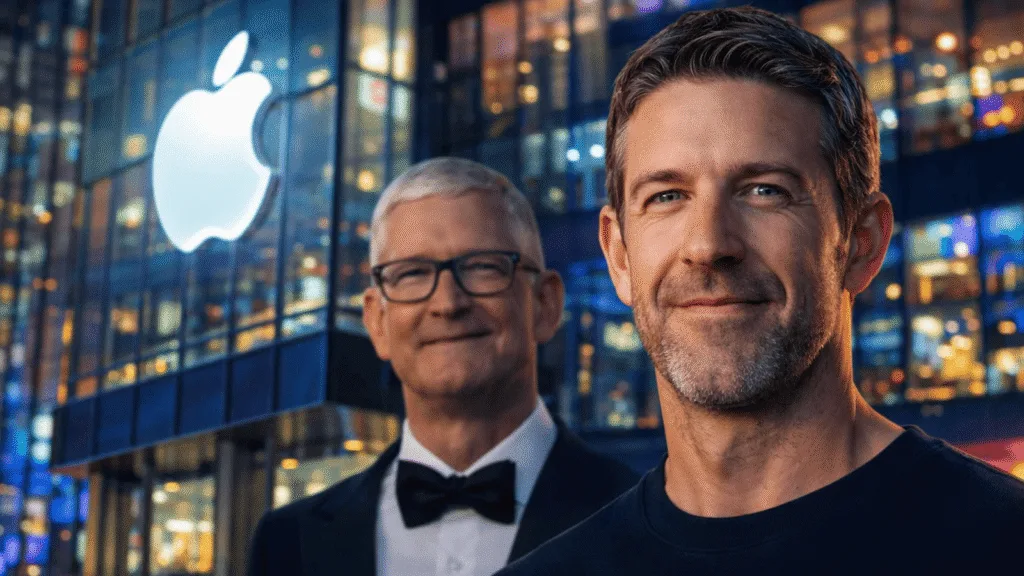



John Ternus will take over as Apple CEO on September 1, 2026, after the electronic giant approved a planned transition from Tim Cook who will remain chief executive through the summer and then become executive chairman. Apple said the move follows a long-term succession plan.
Ternus will also join Apple’s board on the same date, while Arthur Levinson will shift from non-executive chairman to lead independent director.
The market received immediate impetus with the news of the leadership change being made public.

AAPL was trading at $273.05 at the time of writing, with a market capitalization of $4.05 trillion and a trailing P/E ratio of 34.38. MarketWatch data showed the stock moving in a $270.29 to $274.28 intraday range, with a 52-week range of $193.25 to $288.62.
John Ternus inherits Cook’s strong business base
John Ternus is stepping into a company that Cook turned into a consumer electronic’s behemoth. Apple’s market value rose from roughly $350 billion when Cook took over in 2011 to about $4 trillion today. The annual revenue climbed to $416 billion from $108 billion over that span, while Apple’s own statement said revenue nearly doubled and the company cut its carbon footprint by more than 60 percent below 2015 levels during Cook’s tenure.
That record explains why this handoff is less about rescuing Apple’s finances and more about defining its next growth chapter. Cook leaves behind a company that still dominates premium consumer hardware and services, but one that investors increasingly judge against the AI ambitions of Nvidia, Microsoft, Google, Meta, and OpenAI. Apple has lost its perch as the world’s most valuable company to Nvidia as investors weigh Apple’s slower visible progress in AI.
Commenting on the transition, Josh Gilbert, Market Analyst at eToro, said: “Tim Cook’s departure as CEO marks the end of a hugely successful era for Apple, with remarkable shareholder returns and consistent growth. The steady market reaction shows investors are confident in the succession plan, but there will naturally be close attention on what comes next—particularly as Apple navigates a critical period for artificial intelligence.”
Cook’s era also produced clear strengths and sharp criticism. Apple launched successful lines such as the Apple Watch and AirPods under Cook, but did not deliver a step-change hit on the scale of the iPhone. That tension sits at the center of the transition. Ternus inherits a business that still prints cash and commands premium valuation, yet faces constant questions about where the next platform shift will come from.
The immediate challenge: Apple’s AI strategy
John Ternus now takes the top role at the point where Apple’s AI strategy matters more than ever. Reuters reported that Apple has lagged peers in AI and struck a deal in January with Google to use Gemini to improve Siri. Apple has not yet produced a breakout hardware or software hit centered on new AI technologies, even as rivals push AI deeper into search, productivity, devices, and wearables.
That makes Apple’s next public milestones more significant. Apple has already announced that WWDC26 will run from June 8 to June 12, and the company said the event will include AI advancements, software updates, and new developer tools. For investors, that places added weight on how Ternus and Apple frame on-device AI, Siri improvements, developer access, and the balance between privacy, model quality, and cloud reliance.
The leadership profile also matters here. Reuters described Ternus as a product-focused engineer with a pragmatic view of AI, rather than a leader chasing technology for its own sake. That background fits Apple’s culture, where product integration and user experience often take priority over being first. It also raises the bar: the company now has to show that disciplined hardware thinking can still produce faster iteration in an AI cycle that rewards speed and ecosystem reach.
Apple plans a hardware reshuffle
John Ternus will not be handling the transition alone. Apple separately announced that Johny Srouji became chief hardware officer effective immediately. Srouji now leads Hardware Engineering, which Ternus previously oversaw, along with Apple’s hardware technologies organization. Apple said Srouji has driven work across Apple silicon, batteries, cameras, storage controllers, sensors, displays, and cellular modems.
That reshuffle gives a clearer picture of Apple’s operating structure under its incoming chief. Ternus moves up from product and hardware leadership into the top job. Srouji expands control over silicon and device engineering. Cook remains in the building as executive chairman, focused in part on policymakers. Together, that suggests continuity in governance, but a stronger tilt toward product, chips, and hardware execution at a moment when Apple must connect AI more tightly to iPhone, Mac, wearables, and future devices.
Wall Street’s first reaction was constructive. For instance, JPMorgan reiterated its Overweight rating and $325 price target after the announcement. Additionally, TD Cowen kept a $325 target and Wedbush maintained a $350 target. Those calls do not remove the valuation debate, but they show that analysts broadly see the transition as orderly rather than destabilizing.