



TRX price held close to $0.33 on Tuesday after fresh on-chain and corporate updates kept Tron in focus. TRX is trading at around $0.3287 to $0.3293, with a market cap above $31 billion and daily volume near $700 million. The strongest on-chain signal came from Tether activity. CryptoQuant said the total TRC20 USDT supply on Tron reached a new all-time high of 86.7 billion.
Tron has long positioned itself as a high-throughput network built for cheap transfers. That profile fits stablecoin traffic well, and it helps explain why USDT has scaled so aggressively on Tron.
A larger stablecoin base does not guarantee an immediate breakout, but it strengthens the case that network usage remains sticky while traders watch whether the TRX price can retest the $0.35 area.

Justin Sun ties the Arbitrum freeze to Tron messaging
Justin Sun then turned that utility story into a political one. In an X post indexed on April 21, he declared Tron “the most decentralized blockchain in the world.” The timing mattered. It came just after Arbitrum said its Security Council had taken emergency action to freeze 30,766 ETH tied to the KelpDAO exploit.
That sequence gave Sun an easy contrast. Arbitrum showed it could intervene quickly during an emergency. Sun used that moment to argue that Tron looks more decentralized than it does. Whether readers agree or not, the post was a sharp piece of narrative positioning. It linked a rival chain’s emergency control to Tron’s branding in a single sentence.
Still, the claim should stay framed as Sun’s argument, not as a settled fact. Tron’s own documentation shows block production rests with 27 elected Super Representatives. That is a delegated governance model, not an open validator field with thousands of independent block producers. So Sun’s post was more of a governance debate than a measurable conclusion.
TRON structure explains why the decentralization debate persists
The design of the Tron network helps explain both sides of the argument. On one hand, TRX holders can stake, receive TRON Power, and vote for Super Representatives. That gives token holders a direct role in governance. TRON also says those elected representatives rotate block production and validate transactions for the network.
On the other hand, the same structure keeps validation concentrated inside a small elected group. The official documentation is clear that only the top 27 candidates become Super Representatives. That can support speed and low costs, but it also leaves critics room to question how decentralized the system really is relative to networks with broader validator sets.
That is why Sun’s comment drew attention. It did not just praise Tron. It reopened a familiar industry dispute over what decentralization should mean in practice. Is it censorship resistance, validator count, governance access, or the inability to freeze funds under pressure? Arbitrum’s freeze pushed that question back into the center of the market conversation.
TRX price still sits below its December 2024 peak
The market angle remains simpler than the governance argument. Tron Inc said it bought 151,888 TRX at an average price of $0.3292. That pushed its treasury above 692.5 million TRX. The purchase was small relative to daily market turnover, but it added another sign of corporate alignment with the ecosystem at a time when on-chain stablecoin activity was expanding.
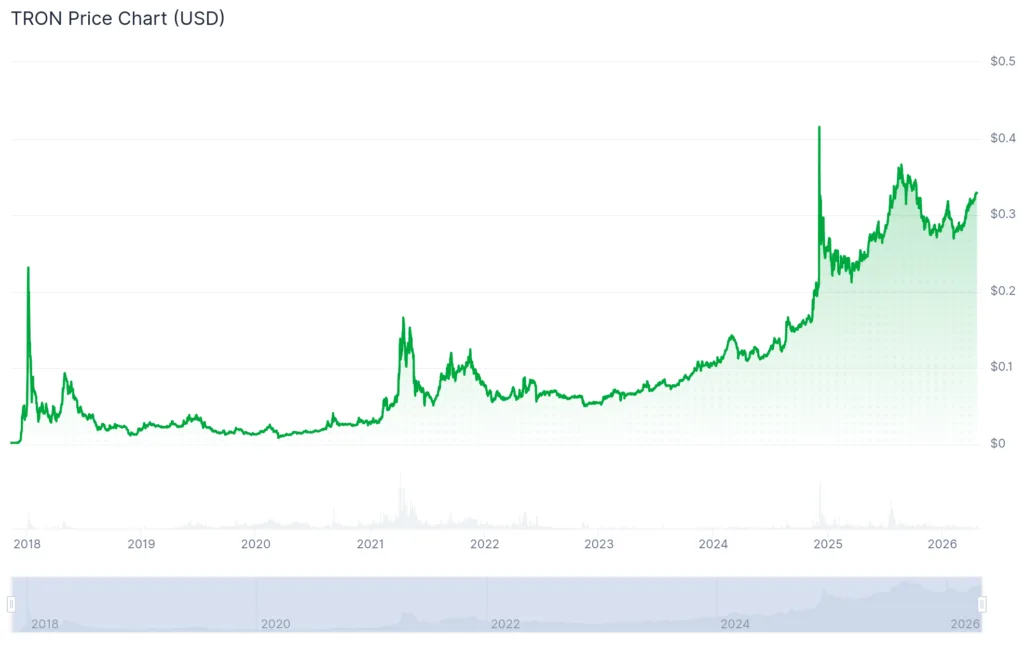
For price history, the main reference point remains the all-time high. Coingecko data shows TRX’s peak at $0.4341 on December 4, 2024. With TRX trading near $0.3285 on April 21, 2026, the token sat about 24.3 percent below that high. A move to $0.35 would therefore look like a meaningful retest level, but it would still leave TRX well under its cycle top.
From a trend perspective, recent daily closes around $0.315 to $0.329 show that Tron has been building from a higher base throughout April.