




AWS Marketplace has added Chainlink’s data standards and services, giving developers and enterprises a direct way to connect cloud systems with blockchain applications. The integration brings Chainlink Data Feeds, Data Streams, and Proof of Reserve services to AWS users.
The move allows firms using Amazon Web Services to combine compute, storage, database, and API tools with smart contracts. It also gives developers access to Chainlink’s oracle services through a platform many enterprises already use.
The update comes as more financial firms explore tokenized assets, stablecoins, prediction markets, and on-chain settlement tools. Chainlink’s role is to connect off-chain data with blockchain systems, while AWS provides cloud infrastructure used by banks, payment firms, and software teams.

AWS adds Chainlink services
AWS Marketplace now supports three Chainlink services aimed at enterprise blockchain use cases. These include Chainlink Data Feeds, Data Streams, and Proof of Reserve.
Data Feeds provide decentralized price and market data. Developers can use them for asset valuation, settlement, and risk management. These feeds are often used by decentralized finance platforms and other smart contract systems that need reliable market data.
Data Streams provide faster market data for real-time applications. The service targets use cases that need low-latency updates, including trading tools, prediction markets, and other blockchain-based financial products.
Proof of Reserve lets developers verify whether stablecoins and tokenized assets are backed by the assets they claim to hold. This service can help institutions monitor reserve data without relying only on internal reports or manual checks.
AWS has also developed reference architectures for some use cases. These include proof-of-reserve monitoring and real-time prediction market trading. The templates give enterprises examples for using Chainlink services within existing AWS infrastructure.
Developers can connect cloud systems to smart contracts
The integration gives developers a familiar route to build apps that connect AWS infrastructure with blockchain networks. It supports hybrid systems that use both traditional cloud tools and smart contracts.
Simon Goldberg, an AWS web3 specialist solutions architect, said AWS provides core building blocks used by financial firms and developers. These include compute, storage, and other cloud services.
“AWS provides the foundational building blocks that financial institutions rely on, including compute, storage, and a comprehensive suite of cloud services,” Goldberg said.
He added that Chainlink’s oracle infrastructure extends those services by connecting AWS resources with smart contracts on blockchain networks. This helps developers move data between traditional software systems and decentralized applications.
“The availability of the Chainlink data standard on the AWS Marketplace allows developers to use familiar AWS services when building applications that interact with tokenized assets and smart contracts,” Goldberg added.
The integration does not require developers to leave AWS tools when building blockchain-connected applications. It instead places Chainlink services inside a marketplace already used by cloud teams, enterprises, and software vendors.
Tokenization demand drives oracle use
The AWS and Chainlink move comes as tokenization gains more attention across finance. Tokenization refers to representing assets such as bonds, stocks, real estate, funds, or commodities on blockchain networks.
These products need external data to work correctly. For example, a tokenized bond may need price data, payment data, or reserve information. A stablecoin may need proof that the issuer holds enough assets to support supply.
Chainlink’s oracle services help smart contracts receive and verify data from outside blockchains. This makes oracles a key part of many tokenized asset systems.
The market has also seen more competition among oracle providers. On April 22,Kalshi announced an integration with Pyth for its Commodities Hub. At the same time, firms such as FTSE Russell, Deutsche Börse, S&P Global, and Coinbase have signed data-related agreements with Chainlink DataLink.
Chainlink has grown into one of the most used oracle networks in crypto. Its decentralized oracle networks have supported many blockchain applications since mainnet launch in 2019. The project says its infrastructure has secured trillions of dollars in transaction value across public and private blockchains.
AWS also holds a major position in global cloud infrastructure. Its marketplace gives enterprise users access to software, data tools, and services that can be deployed within their existing cloud environments. The addition of Chainlink services may make blockchain data tools easier for those users to test and adopt.
LINK price holds near $9.40
Chainlink’s LINK token traded near $9.40 at the time of writing. The token was up about 1.55 percent over 24 hours but remained down about 4.32 percent over the past seven days, according to CoinGecko data.
LINK had a 24-hour trading volume of about $228.9 million. With a circulating supply of about 730 million LINK, Chainlink’s market value stood near $6.84 billion.
The token remained in a sideways recovery range after the sharp January and February decline. LINK has held above the lower $8 area, but it has not confirmed a wider breakout. A move above the $9.80 to $10.00 zone would give buyers a stronger short-term setup.
The RSI stood at 55, slightly above its signal line at 53.76. This shows mild buying pressure, but LINK is not overbought. The RSI has stayed mostly above the neutral 50 level in recent sessions, showing that buyers have kept some control.
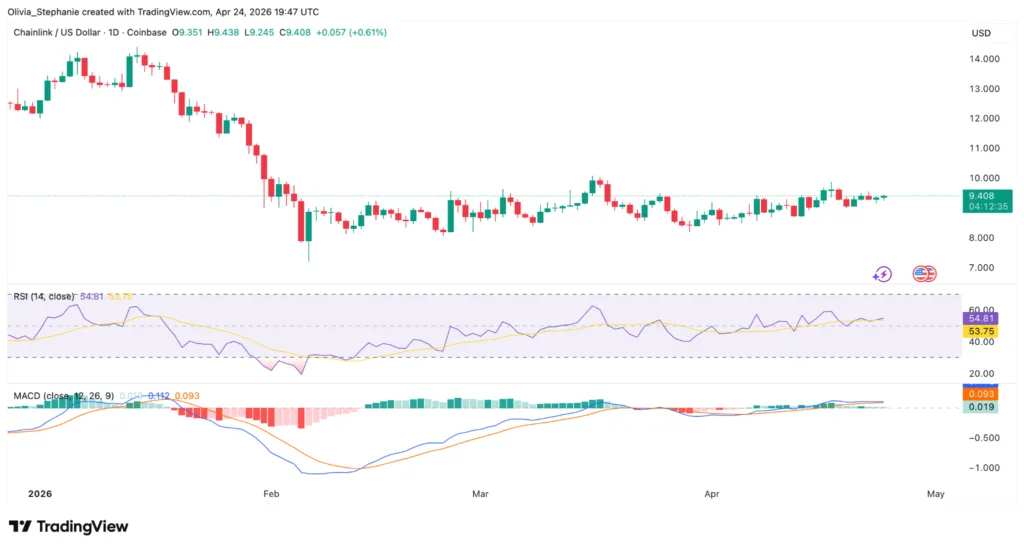
The MACD showed a small positive histogram reading of 0.020. The MACD line stood at 0.113, above the signal line at 0.093. This points to a weak bullish setup, but the small gap between the lines shows that momentum remains limited.
A sustained move above $10 could strengthen the current recovery. A drop below $9 could weaken the setup and bring attention back to lower support areas.
Chainlink Reserve also added more LINK in its latest update. The reserve accumulated more than 123,000 LINK, valued above $1.14 million at recent prices. Total reserve holdings now stand above 3.3 million LINK, worth about $30.6 million.