




Solana price prediction moved back into focus after SOL rallied alongside Bitcoin’s push above $74,000. The move lifted Solana by roughly 4.5 percent to 5.2 percent across the session, with spot price hovering near $85.89 to $86.23.
Market capitalization stood near $49.65 billion, while daily trading volume climbed sharply above $5 billion.
The latest rise placed SOL near an important decision zone rather than a confirmed breakout. Price reached the upper end of a short-term parallel channel and then eased slightly, leaving traders focused on whether buyers can hold control near the highs. That matters because the $87 to $90 area has emerged as the most immediate barrier on several short-term readings.

Broader market sentiment helped the move. Bitcoin’s breakout added momentum across large-cap cryptocurrencies, while Ethereum also advanced strongly during the same stretch.
Total crypto market capitalization rose above $2.5 trillion, showing that the Solana’s move did not happen in isolation.
Even so, the rally arrived in a market that still carries macro uncertainty. Geopolitical tension in the Middle East has not fully faded, and crypto remains sensitive to shifts in headline risk.
That keeps the near-term Solana price prediction tied both to its own chart structure and to wider market tone.
Solana price prediction gets policy boost from stablecoin proposal
A major fundamental angle came from Solana co-founder Anatoly Yakovenko, also known as Toly, during the debate around USDC freezing powers. He argued that base-layer dollar stablecoins should only be frozen under a U.S. court order. His view drew a hard line around what qualifies as a true digital dollar.
The proposal came after criticism of Circle’s handling of stolen USDC linked to hacker incidents.
Some community voices argued that the response around freezing actions looked inconsistent. Yakovenko answered by proposing a layered structure for stablecoins.
Under that model, the base layer would remain tightly limited and only respond to court-authorized orders. On top of that, protocols such as Drift and Kamino could issue wrapped stablecoins with their own controls, security teams, and incident response systems.
That design would separate the legal foundation of the asset from the operational decisions of application-layer products.
This debate matters for Solana because stablecoins sit at the center of trading, payments, and decentralized finance activity on the network. Clearer rules around freezing powers could improve trust for some users, especially those who want predictable legal standards. At the same time, the issue also exposes how dependent parts of crypto remain on centralized issuers.
The policy backdrop widened further after U.S. lawmakers introduced the Digital Asset PARITY Act. The proposal would exempt certain stablecoin payments from tax when the asset stays within 1 percent of its peg. The draft aims to treat regulated stablecoins more like cash for small daily transactions, reducing reporting friction.
That proposal followed the 2025 GENIUS Act, which laid out a federal framework for permitted payment stablecoins.
Together, the bills show that stablecoin policy remains one of the clearest bridges between crypto infrastructure and mainstream use. For Solana, that matters because higher stablecoin use often feeds directly into transaction growth, trading activity, and DeFi expansion.
Solana network data keeps the Solana price prediction supported
The Solana network continues to post strong usage data. It led blockchains in transaction volume during the first quarter of 2026 with more than 25.3 billion transactions. February stablecoin volume also reached about $650 billion, pointing to deep activity across transfers and trading.
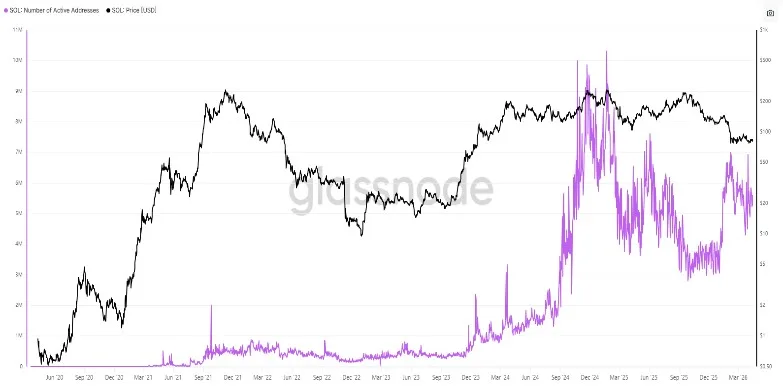
On-chain adoption looks strong as well. Glassnode data showed token holder addresses reaching a record high near 167 million in April. That figure gives the market a concrete sign that network reach continues to expand, even while price remains below prior cycle highs.
Growth across decentralized finance adds another layer. New lending protocols, tokenized real-world asset activity, and broader application use continue to build on Solana. These trends help explain why network usage has stayed resilient even during periods when price action turned mixed.
Solana price prediction faces mixed signals on RSI, MACD, and averages
Short-term indicators lean constructive, but they do not present a one-way bullish case. The 14-day RSI is near 68, which places SOL close to overbought territory without crossing it. That reading suggests buyers still have momentum, though not much room before the market starts to look stretched.
The MACD has shown a modest positive crossover, which supports the idea of near-term strength if volume remains elevated. Solana has also traded above its 5-day and 20-day moving averages near $85, indicating that buyers have controlled the very short-term trend.
At the same time, other moving average readings remain less friendly. SOL still sits below the 50-day EMA near $87.43, while the 100-day and 200-day EMAs near $99.19 and $118.32 create stronger overhead pressure. In other words, the short-term structure improved, but the broader recovery remains incomplete.
This split helps explain why current price action looks strong on intraday and daily charts, yet still faces caution on higher timeframes. Traders are not looking at a fully cleared path. They are looking at a market trying to push through layers of resistance after a rebound.
Volatility also remains elevated. An average true range near $3.94 leaves enough room for fast swings in both directions. That means the next move does not need many sessions to become obvious. A break higher could extend quickly, but rejection could also unwind rapidly.
Solana price prediction now hinges on the $87 to $90 resistance test
The most immediate resistance sits between $86.50 and $90. Several chart readings place the first barrier near $87 or $87.43, with further resistance around $88 and $92. That cluster makes the current zone the key test for bulls.
If SOL clears $90 with sustained daily volume above $300 million, momentum models could shift decisively higher. In that scenario, the next upside path points toward the $95 to $105 region. The psychological $100 level would then become the next major reference point.
On the downside, first support sits around $85.50 and then $84.00. The range between $84.80 and $86.00 has also been marked as a near-term entry zone in some market readings. Below that, the more important support band lies near $81.50 to $82.75. That zone has acted as a floor several times during recent range trading.
A break below that support would weaken the rebound structure and reopen the path toward $77.50 and then the broader $75 to $79 region. Some analysts have also placed protective stop levels around $82.90, which underlines how closely the market is watching that band.
Ali Charts has framed the longer-term picture differently. In his broader channel view, $49 remains the main support and $108 stands as immediate macro resistance. That reading strips away short-term noise and keeps Solana inside a larger upward channel, but it also shows how much room still exists between local resistance and higher-cycle targets.
Solana price prediction also carries a bearish chart risk
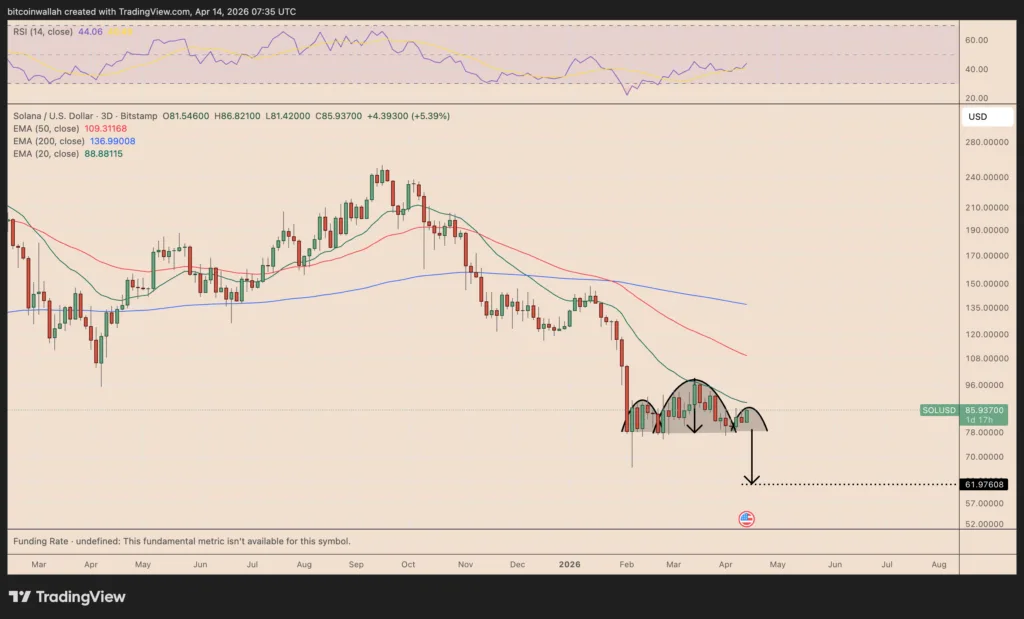
The bullish case is not the only active setup. Solana’s three-day chart reveals a possible head-and-shoulders structure, with a left shoulder in late February, a head near $100 to $105 in mid-March, and a lower right shoulder in early April around $90. That pattern points to fading momentum across each rebound.
The neckline for that setup sits near the $78 to $80 zone. If price breaks below it with conviction, the pattern would confirm and open the door to a deeper drop. The measured move from that formation points toward roughly $56 to $60, implying downside of around 25 percent from recent levels.
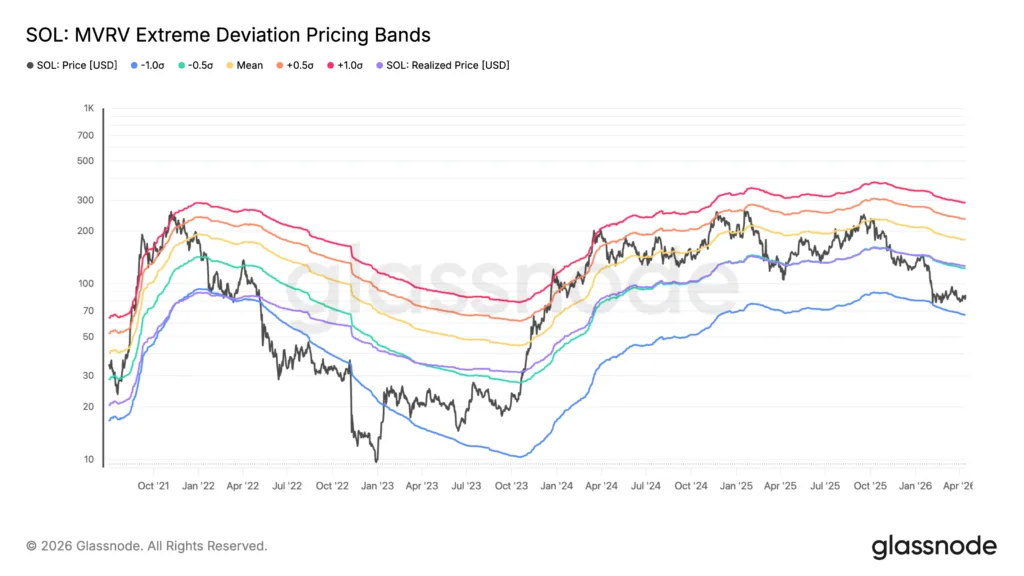
On-chain valuation models have added to that caution. Solana has drifted below the mean zone in the MVRV Extreme Deviation Bands and hovered near the minus 0.5 sigma level. Historically, failure to hold that area has often pulled price toward the minus 1.0 sigma band, which currently sits near $66.6.
That does not mean the bearish scenario will play out immediately. It means the market has two active maps at once. One map supports a push toward $90 and possibly $100 if buyers keep control. The other warns that failure near resistance could turn quickly into a much larger unwind.