




Fellowship PAC, a crypto-backed super PAC, has been the first known to make a purchase in the 2026 US midterm cycle, spending $300,000 to place an ad in support of Georgia Republican Clay Fuller.
The expenditure marks the initial known expense by the group since its launch in 2025 when it reported over $100 million in funding by crypto-aligned supporters.
According to filings by the Federal Election Commission, the money was spent on advertising that was associated with Fuller, who recently won a special election to the 14th Congressional District of Georgia after Marjorie Taylor Greene resigned.

The expenditure was about one month before the Republican primary in Georgia on May 19. It also causes Fellowship to be among the first crypto-linked groups to initiate the direct election activity in the 2026 cycle.
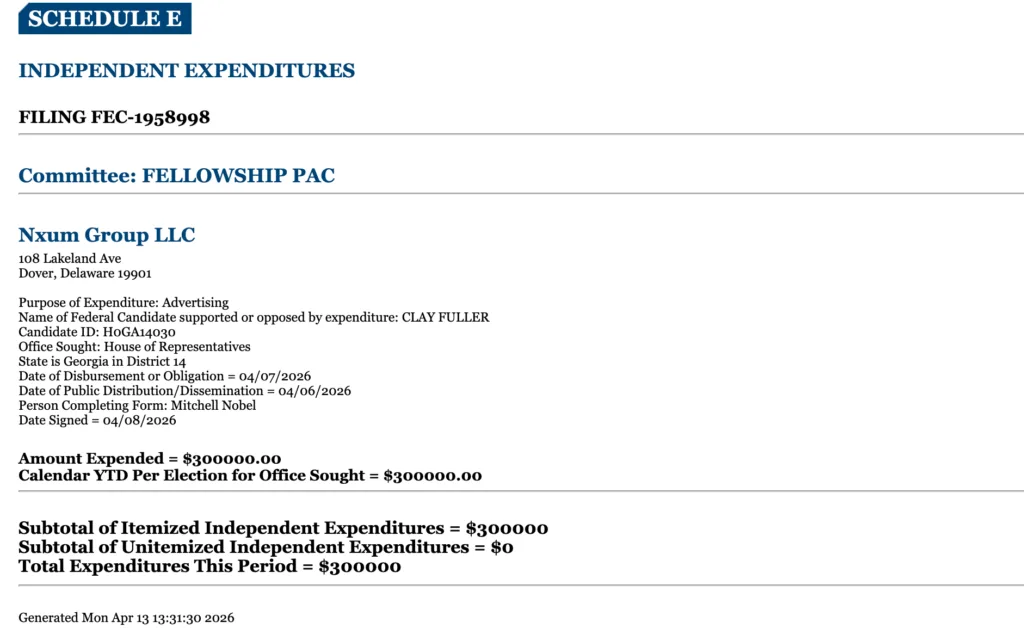
First spending puts Fellowship into the 2026 race
The filing placed Fellowship into a growing group of political committees backed by crypto interests ahead of another major election season. In 2024, crypto-backed groups such as Fairshake spent heavily on congressional contests, with media buys exceeding $130 million.
Those efforts drew attention across Washington and showed how digital asset firms and supporters were prepared to use campaign spending to back candidates seen as favorable to the sector.
Fellowship had remained quiet for months after its launch announcement in September 2025. At that time, the PAC said it had “over $100 million” in support lined up from undisclosed contributors connected to the crypto industry.
Public disclosures, however, had not yet shown cash in its accounts, and the first visible spending only appeared in the latest FEC filing tied to Fuller’s race.
The PAC also moved into public campaigning through social media. It posted endorsements for several Republican candidates across five states. Those endorsements included Alan Wilson for South Carolina governor and Blake Miguez for Louisiana’s 5th Congressional District.
They also backed Mike Collins for the US Senate in Georgia, Julia Letlow for the US Senate in Louisiana, Pete Ricketts for the US Senate in Nebraska and Nate Morris for the US Senate in Kentucky.
Fuller was not included in that list of endorsements even though the PAC had already reported spending on his behalf.
That left open questions about the group’s campaign strategy and how it plans to present future backing for candidates as the 2026 cycle moves forward.
Tether links draw added attention
Attention around Fellowship increased after the PAC named Jesse Spiro, head of government affairs at Tether’s US business, as its chairman on April 1. The appointment connected the group more closely to the stablecoin issuer at a time when crypto political activity is under closer review in Washington.
Fellowship said it would support candidates who back digital asset growth and who want the United States to remain a leader in next-generation financial infrastructure.
The first disclosed payment also drew notice because it went to Nxum Group, a company co-founded by Bo Hines. Hines previously served as a crypto adviser to President Donald Trump and now leads Tether US.
The payment raised questions because Fellowship had promoted itself as a committee “rooted in transparency” and as a group meant to serve the wider crypto sector rather than narrow interests.
Campaign finance experts noted that such arrangements are not automatically prohibited under US law. Michael Beckel of Issue One said, “There is no blanket prohibition on self-dealing when we’re talking about political committees like this.” He added that the general rule is that services must be real services and paid at fair-market value.
Tether responded by saying Tether International has no affiliation with or oversight over Fellowship PAC.
Moreover, the company did not provide further detail on whether Tether US had any role in the PAC’s activity. Fellowship also did not respond to questions about its funding, structure or the payment to Nxum.
Transparency claims face an early test
The group’s financial filings have not yet shown the source of the money it said was committed last year. Fellowship’s federal reports still showed zero in current accounts even after the first expense filing.
That does not rule out money being raised or moved, because campaign finance reporting often trails the actual transfer of funds, but it leaves the public record incomplete for now.
That gap matters because Fellowship introduced itself as different from earlier crypto political efforts. When it launched, the PAC said it would be “defined by transparency and trust” and would operate in a way that served the broader digital asset ecosystem. Its first spending report, combined with the lack of disclosed contributions, has put that message under early scrutiny.
The PAC’s treasurer, Mitchell Nobel, is an executive at Cantor Fitzgerald, the financial firm that manages assets for Tether’s global business. That added another layer of attention to the group’s network of relationships.
None of those ties, by themselves, show wrongdoing, but they have increased interest in how Fellowship will handle future disclosures and how quickly donor information becomes public.
Clay Fuller’s own record on crypto policy is still limited in the public domain. He has support from President Trump, who called him “a wonderful and talented man,” but Fuller does not yet have a crypto policy grade from Stand With Crypto, a group that tracks candidates’ positions on digital asset issues.
Crypto policy battle continues in Washington
The PAC’s entry into the election cycle comes as Congress continues to debate crypto regulation. The CLARITY Act, passed by the House in July, remains stalled in the Senate.
There was no clear way to pass even by Monday, although there were suggestions over the weekend that the Senate Banking Committee was gearing up to mark up the bill.
Some of the issues related to the legislation are still being discussed by the lawmakers such as rules of ethics, stablecoin yield, tokenized equities and general questions of the market structure.
The unresolved issues have continued to make the bill not move fast as crypto firms and advocacy groups continue to urge the government to enact clearer rules before the next election.