
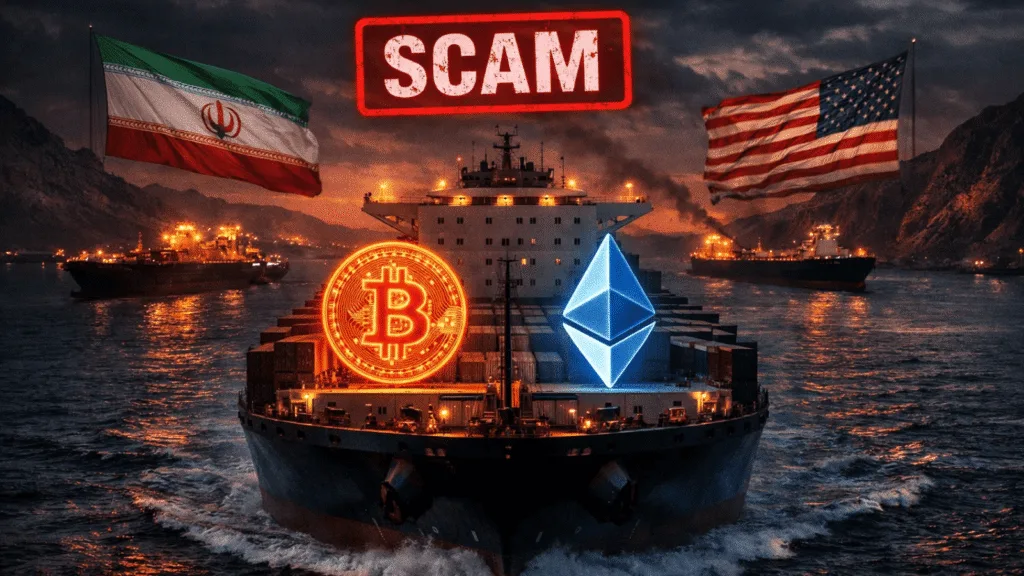



Shipping companies near the Strait of Hormuz are now face a growing wave of crypto-related fraud linked to rising geopolitical strain. Reports show that malicious actors are exploiting restricted access to the waterway by offering guaranteed passage in exchange for digital asset payments.
Maritime risk monitoring firm, MARISKS, believes that unknown groups have been targeting vessel operators under the guise of Iranian officials and giving transit approvals. These counterfeiters say they can grant safe passage when the companies provide documents and are prepared to pay a fee using either bitcoin or USDT.
In addition, the messages tend to have structured messages and reviewing procedures, making them more credible and difficult to detect as fraudulent. As a result, operators that are passing through a corridor that is already tense, have an additional problem of financial fraud in addition to physical security.

The Strait of Hormuz is among the most important international shipping routes though in the recent past, it has been affected by disturbances that have slowed the usual traffic. Also, rival embargo of the United States and Iran still makes operational choices of commercial fleets that pass through the region complicated.
Fraudsters exploit geopolitical tension to demand crypto payments
Moreover, MARISKS reported that one of the vessels had just been involved in gunfire when trying to leave the strait, with uncertain circumstances. Such incidents, according to analysts, can be linked to larger-scale attempts of deceiving shipping companies in the present state of instability.
In the meantime, the fraud has come into the limelight as well as deliberation in Iran on the introduction of transit fees on crossing the strait by ships. It has been reported that the authorities have thought about charging per shipment by tolls, and cryptocurrency is not left out of the list of payment options.
Meanwhile, Donald Trump has defended the U.S. ban on Iranian ports by saying it would not be lifted until a larger agreement is established. This has made shipping companies still work under the high level of uncertainty as they wait it out to get an understanding of the diplomatic events.
In addition, current ceasefire between the United States and Iran is nearing its expiry date, which mounts pressure on operators. Businesses will have to have a quick decision-making process and weigh the maritime security threats and financial risk associated with the scam crypto schemes.
KelpDAO exploit triggers DeFi shockwaves across lending markets
According to Coinheadine, another interference in the decentralized finance has increased risk in interconnected crypto markets. The KelpDAO attack emptied approximately 116,500 rsETH via a vulnerable cross-chain bridge route, and the loss was estimated to be approximately $292 million.
The attacker is also said to have transferred the stolen funds into Aave markets where he used the assets as collateral to access additional liquidity. This compelled emergency containment actions and caused an apparent decrease in total value locked on the platform. In addition, governance discussions showed that the entire pools were still running, and the problem was confined to rsETH exposure and not a direct protocol bug. Nonetheless, the users responded swiftly by withdrawing money, which hastened the overall DeFi liquidity squeeze.
The targeting of vessels in the Strait of Hormuz by crypto scams demonstrates a growing interdependence of geopolitical tension and risks in digital assets. With maritime disruption and DeFi instability, global operators need to learn to live in a fast-changing environment of threats.