




Polish Prime Minister Donald Tusk said a crypto company with alleged Russian links backed political forces opposed to his government as Poland’s dispute over crypto regulation returned to parliament on April 17.
Speaking before lawmakers, Tusk said Zondacrypto had supported politicians from the former ruling camp and sponsored a CPAC event in Poland where Kristi Noem backed nationalist candidate Karol Nawrocki during the presidential race.
Tusk made the remarks during a parliamentary push tied to legislation meant to regulate Poland’s crypto-asset market.

According to the Associated Press, he argued that resistance to the bill served the interests of a specific firm and linked that firm to Russian money, the Bratva, and Russian secret services. He also said Nawrocki was “fully aware” of details surrounding Zondacrypto when he vetoed the legislation.
The case has turned a regulatory dispute into a wider political fight. Poland’s government says the proposed rules are needed to bring the country into line with the European Union’s crypto framework. Opponents say the bill is too harsh and could damage the local crypto market.
Tusk ties crypto sponsor claims to the veto fight
Tusk’s comments centered on Zondacrypto, which he said had provided financial support to politicians and had links to Russia.
“The source of this company’s financial success is not only Russian money linked to the so-called Bratva, one of the most important mafia groups in Russia, but also to Russian secret services,” he stated in parliament.
The Associated Press reported that Tusk presented the allegations as part of his case for stronger crypto oversight.
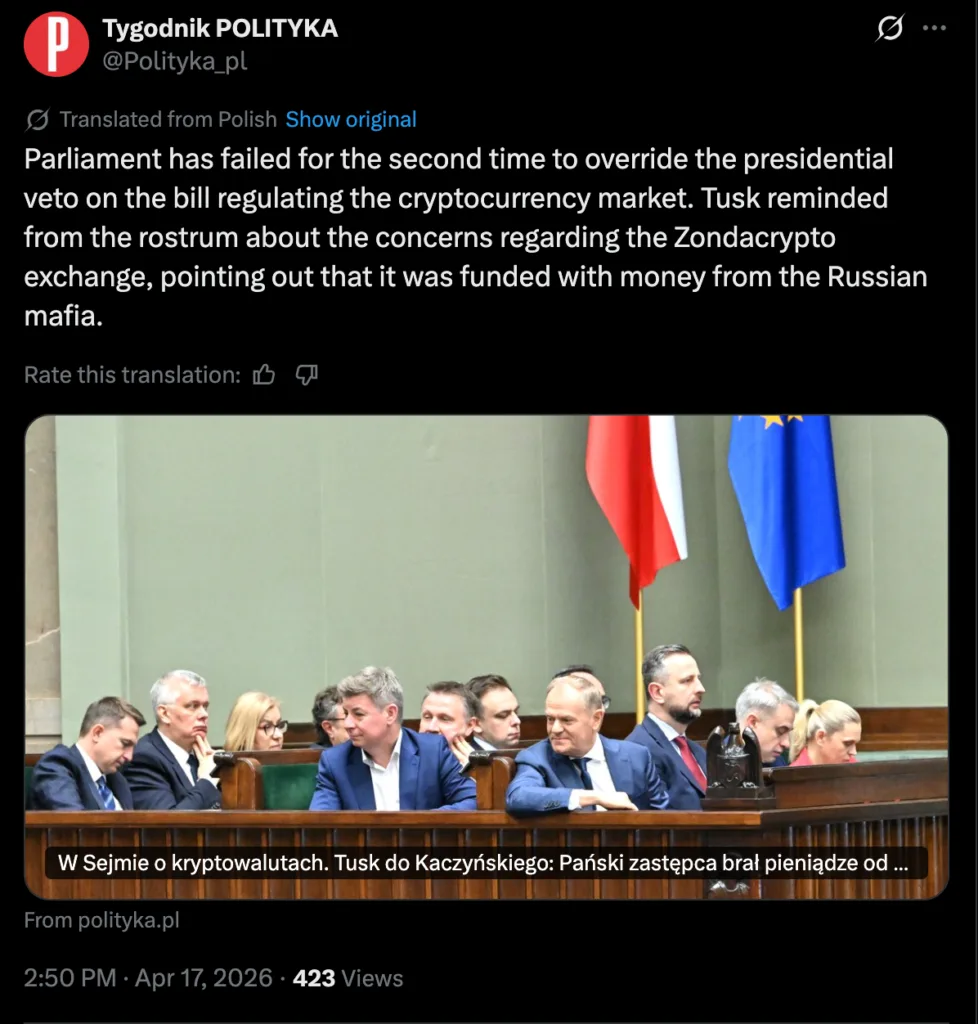
He also linked the company to a CPAC gathering held in Rzeszow in March 2025. Tusk said Zondacrypto was a strategic sponsor of that event, which took place days before Poland’s presidential election.
At the conference, Kristi Noem openly backed Nawrocki and criticized the liberal camp’s candidate. Tusk used that link to argue that the debate over crypto law cannot be separated from broader political financing and outside influence claims.
The accusations came as parliament debated whether to override Nawrocki’s veto. The crypto bill is part of Poland’s effort to establish a domestic framework for crypto-asset service providers in line with the EU’s Markets in Crypto-Assets regulation, widely known as MiCA.
Poland has struggled to complete that process after repeated clashes between the government and the president’s office.
Nawrocki’s office and critics reject the government’s case
Nawrocki’s office pushed back against Tusk’s claims. Zbigniew Bogucki, who heads the president’s office, said Nawrocki did not oppose regulation itself but objected to what he called a flawed regulatory model. That response kept the focus on the design of the bill rather than the allegations raised by Tusk in parliament.
Confederation leader Sławomir Mentzen also opposed the proposed law. He said the legislation would have ”destroyed the Polish cryptocurrency market,” according to AP.
Critics of the bill have argued for months that Poland’s version of MiCA implementation is more restrictive than approaches taken in other European countries and could push firms abroad.
Zondacrypto did not reply to questions on Tusk’s accusations, though the company told Polish media earlier in the week that it was cooperating with Polish authorities looking into the matter.
That leaves the political argument moving faster than any public legal finding tied to the claims made in parliament. At this stage, the accusations remain allegations made by the prime minister, while the company and the president’s allies reject the political framing around the bill.
Poland’s MiCA delay keeps the crypto market in limbo
The latest clash follows earlier setbacks in Poland’s attempt to align with MiCA. In December 2025, parliament failed to gather enough support to overturn Nawrocki’s veto of an earlier crypto bill.
That vote left Poland behind on its regulatory path as other EU states moved ahead with national arrangements under the same bloc-wide framework.
Reports in early 2026 said Nawrocki vetoed another version of the crypto-asset market bill in February, keeping the issue unresolved. The disputed rules were meant to set a national licensing regime for crypto businesses and define the role of Poland’s financial regulator in supervising the sector.
With another veto and more political conflict, firms operating in the country continue to face uncertainty over how the local market will be supervised before the EU transition period runs out.
Additionally, the government says the law is needed to bring Poland into compliance with EU rules. Its opponents say the draft is too burdensome.
That divide has now widened beyond market structure and licensing into questions about campaign support, foreign influence, and the role crypto companies may play in domestic politics.
Russian sanctions and crypto scrutiny add to the pressure
Tusk’s remarks also land at a time of wider scrutiny around Russia-linked crypto activity. In February, the U.S. Treasury sanctioned Russian cyber firm Operation Zero and several related individuals after an Australian national pleaded guilty in a case tied to stolen software and crypto payments.
That action added to a wider pattern of Western agencies targeting alleged Russian-linked cyber and crypto networks.
Moreover, market research has kept attention on Russia-facing crypto channels. As we reported in February, some exchanges linked to Russia have helped users move funds outside regular banking rails even as sanctions remain in place.
Meanwhile, those concerns have fed a broader policy debate in Europe over whether crypto oversight should move faster when national security questions arise.
In Poland, that debate is now tied directly to a domestic political battle over Zondacrypto, Nawrocki’s veto, and the future of local crypto regulation.