



DeFi protocol manager Aave Labs has put forth an integrated proposal to help compensate the rsETH holders who suffered major losses in the Kelp DAO hack.
According to a proposal published on Saturday, Aave suggests that the organisation behind Arbitrum should unfreeze $73.5 million in Ether tied to the Kelp DAO attack and direct the funds to “DeFi United,” a fund aimed at restoring rsETH and compensating its holders.
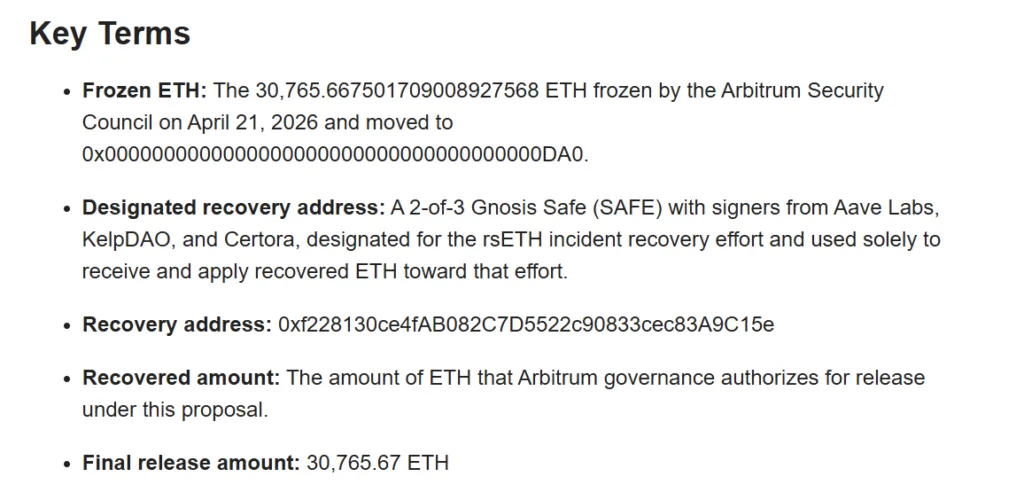
The move follows the Arbitrum Security Council’s previous attempt to freeze 30,765 Ether (ETH) held in a wallet connected to the $293 million Kelp exploit.

In the proposal posted on the Arbitrum governance forum, Aave Labs stated that directing those funds to a planned remediation effort would “restore normal conditions for Arbitrum users” and the larger ecosystem.
The DeFi protocol manager is also of the opinion that the Ether on Arbitrum “represents a material contribution” toward restoring the Kelp DAO restaked ETH (rsETH) token.
The contribution was submitted with the assistance of Kelp DAO, LayerZero, Ether.fi, and Compound, four of the crypto systems affected by the attack.
DeFi united sees high contribution after Kelp hack
The proposal comes a few days after Aave Labs and others established the “DeFi United” on Friday in an attempt to totally regain rsETH’s support.
According to data from Dune Analytics, contributions totalling approximately $21 million have already been made by Aave Labs CEO Stani Kulechov, Aave Labs head of contracts Emilio Frangella, Kelp DAO, Golem Foundation, Web3 development platform BGD Labs, and Babylon, a Bitcoin-native DeFi protocol.
Arbitrum, Mantle, Ether.fi, and Lido have also committed an additional $215 million to support the recovery effort. The commitments, however, are up for governance votes.
Other protocols such as Frax Finance, Ethena, LayerZero and the Ink Foundation have also expressed their willingness to help.
Kelp DAO hack
The Kelp DAO hack occurred on April 18th and 19th, 2026, leading to the theft of about $292 million to $294 million worth of crypto.
The attack has been considered as one of the biggest DeFi exploits during the year, drawing attention due to the magnitude of the breach in the crypto world. The exploit happened in an environment where the broader digital asset ecosystem has been facing an increase in breaches and hacks.
According to market reports, the amount of losses attributed to DeFi hacks and exploits as of late April 2026 stands at more than $771.8 million. Given that the current year is not yet halfway through, it is already 15 percent to 25 percent higher compared to the predicted $600-$650 million DeFi hack loss totals for 2025.
When it comes to the Kelp hack, the hackers targeted their DAO’s liquid restaking token called rsETH, through which investors can generate more yields on staked tokens.
The reason for the hack was identified in the vulnerability within the project’s cross-chain bridge solution, a feature that enables transfers across multiple blockchains. The technology had been developed using solutions from the LayerZero Labs platform.
The seven week time
In the report, Aave proposes setting the recovery period at seven weeks to recover the token rsETH. However, the DeFi platform has confirmed that a “full recovery” is impossible.
According to Aave Labs, “even a partial recovery would still meaningfully reduce the shortfall.”
Specifically, the platform has requested that 30,765 Ether be transferred to the recovery address controlled by Aave, Kelp DAO, and Certora, a blockchain security firm.
According to Aave Labs, it will return the funds if the recovery attempt fails, and it expects that the recovery period of rsETH and repaying its users would take about 49 days.