




The moment markets breathe but do not relax
The word ceasefire travels through markets faster than any economic indicator. The concept exists as an indicator which is not based on any numerical value or mathematical framework or collection of data. It serves as a signalling device. The market responds immediately after the signal reaches the market. The dollar softens. The market needs to return to riskier investments. Market participants who planned to sell their stocks now dedicate their assets toward high-risk investments which include growing companies and unpredictable investment prospects.
The immediate interpretation is simple:the worst-case scenario is off the table. The markets operate to establish value based on what actually happens. A ceasefire does not erase what has already been disrupted. The process does not lead to supply chain emergencies which need instant resolution. The process requires time to establish new inflation expectations which will last. Investors need more stability than what the current situation provides.
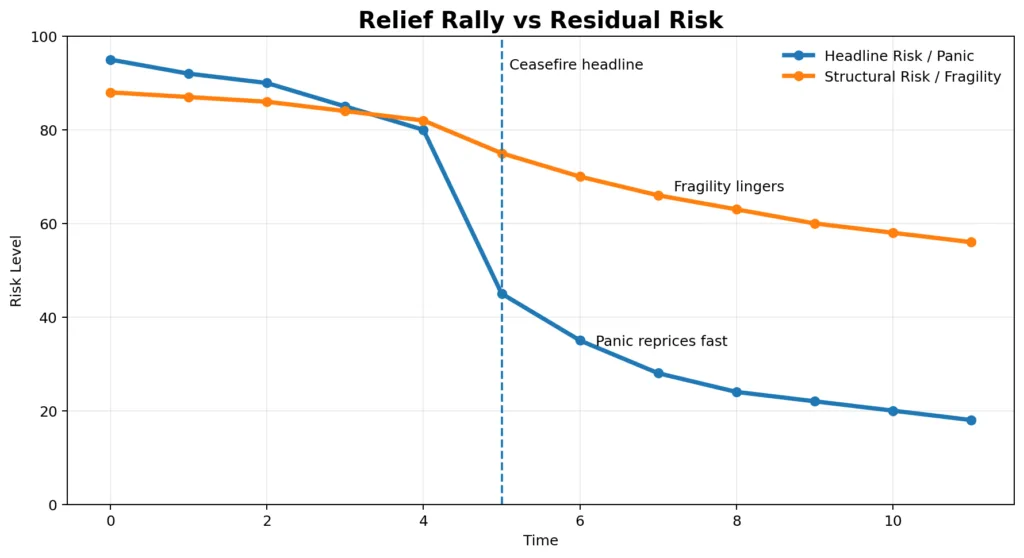
The process creates more important effects which provide more valuable results. The process of spreading fear through society starts to decline while people maintain their current danger assessment. The process of ceasefire economics leads to this double bind situation. The situation of danger continues to exist because panic no longer shows any growth.

Relief rallies are mechanical, not emotional
The first reaction to a ceasefire is often misunderstood as optimism. The second reaction to a ceasefirefirst reaction to a ceasefire. The first chill of the day and the first heat of daytime create two distinct weather patterns. When wars intensify, markets begin to forecast their results through testing because of the war events. The markets forecast their standing to which they would deliver winning results.
The distribution pattern starts to narrow down its range. The probability of losing tail risks decreases but does not completely vanish. The process of compression leads to the need for repositioning. Traders who maintain short positions will close their trades.hedge positions will be closed by traders.
Traders who sell volatility will come back into the market. Investors who take risks will find their assets to be more liquid. Traders will create the appearance of a relief rally which actually serves to adjust their market positions. Equity indices can move up even when the economic situation remains unchanged because of this fact. The rally is not a reflection of growth. Uncertainty has decreased yet some of it still exists.
Oil: The market that refuses to believe the narrative
The stock market reacts positively to peace agreements while the oil market tests those agreements. Energy markets do not react to headlines alone. They respond to physical constraints which include shipping routes and production capacity and control points that geopolitical powers maintain. The current situation has those constraints operating at a weak level.
The announcement of a ceasefire does not provide security for the Strait of Hormuz which serves as one of the world’s most important energy passageways. Tanker insurance expenses take time to return to their normal levels. Strategic reserves require multiple days for their complete restoration. Supply chains keep their memory of past disruptions.
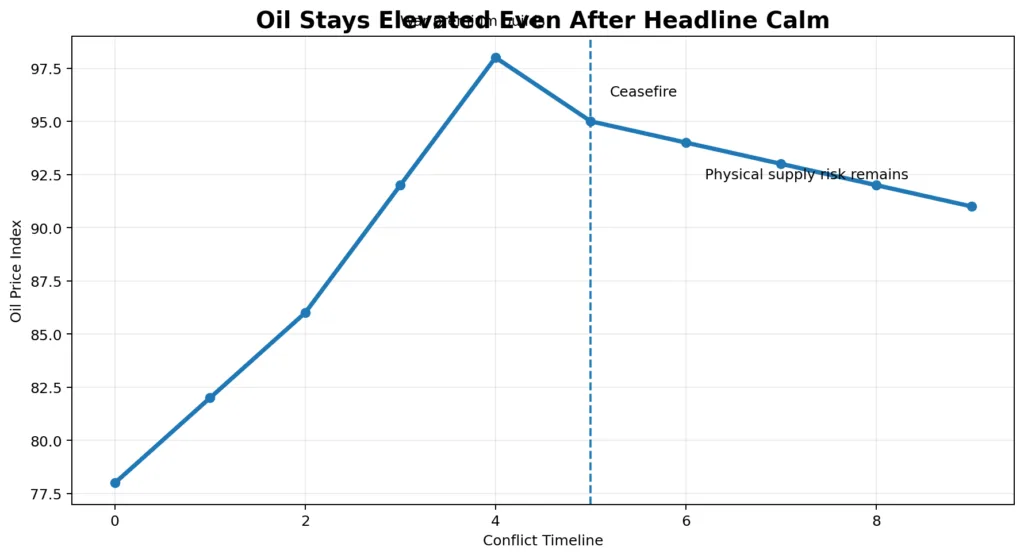
The ongoing conflict results in high oil prices which continue to exist despite positive news about potential ceasefires. The energy market indicates that although fighting has stopped, normal operations remain disrupted. Oil functions as the reliable source of accurate information in this situation. The energy policy reflects what scientists expect to occur in the future yet the physical world has yet to achieve that result. The ongoing high oil prices create an active risk of inflation because price increases continue to occur.
Gold: The memory of fear
Gold does not chase headlines. It absorbs them.When geopolitical tension rises, gold becomes the immediate beneficiary of fear. The present time becomes interesting because gold experienced price increases during warfare. The present situation shows gold maintains its value during the period which people expect ceasefire agreements to begin.
The behavior of investor markets shows that people choose to avoid risk. The researchers found that investors still doubt whether the situation has become stable. The investors have started to decrease their emergency response measures while they maintain their protective strategies.
The investors have chosen to move their assets but they still keep part of their protective investments. Gold functions as a historical record which people use to remember their deepest fears. The market maintains its current uncertain state because it still holds unknown elements.
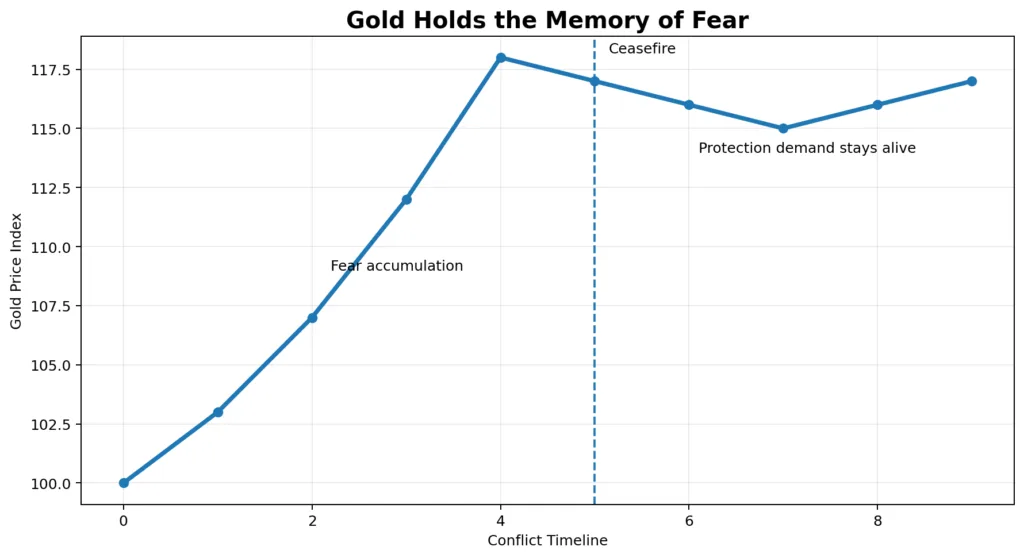
The market conditions show two main issues which include people doubting currency stability and inflation and deepening geopolitical disputes. The main finding shows that trust which once broke has slower recovery than public sentiment. A ceasefire can stop escalation. It cannot erase memory.
Crypto: Trading the gap between narrative and reality
Crypto operates between two states which represent immediate responses and strong beliefs. The crypto market receives positive effects when geopolitical tensions decrease because investors develop better risk assessment skills. Investors start to shift their money towards high-risk investments. The market begins to experience better momentum. The marketable growth stories which create fresh innovations display their full potential.
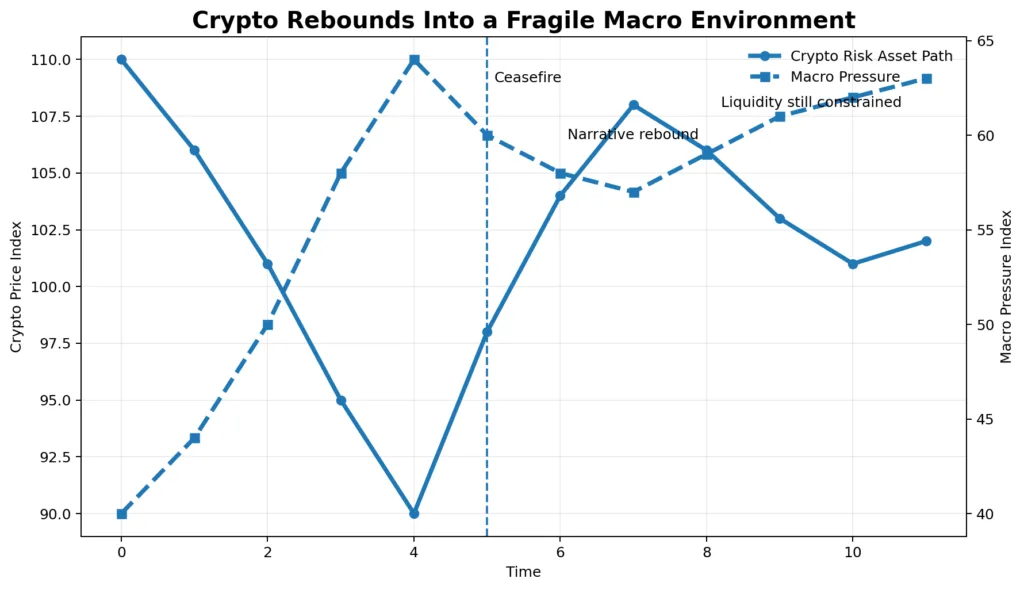
Crypto markets depend heavily on current market capacity to handle financial transactions. Financial markets experience liquidity changes because temporary ceasefire agreements do not provide complete solutions. Market liquidity levels depend on three main factors which include interest rate changes and inflation forecast and economic conditions. The ongoing high oil prices create permanent danger of inflation.
Central banks maintain their operational limits as long as inflation continues to exist. Central banks face operational limits which make it difficult to create new liquidity while risk markets expect better market conditions. A gap exists between two different things which need to be separated from each other. The existing gap between two different things creates two different states which exist between recovery and macroeconomic pressure.
The cryptocurrency market operates within that space which exists between two opposing forces. The system shows immediate response to optimistic news while all other economic conditions continue to stay in their current state of existence. Market conditions create powerful rallies which exist in two opposite states of movement. Market conditions create strong upward movement which currently lacks essential fundamental progress.
The hidden cost of a ceasefire
The primary results that come from a ceasefire demonstration their main impact through time because they create permanent changes. The effects of warfare on international systems reach beyond the active combat zones. The systems used to supply goods experience complete structural changes.
The cost of insurance coverage for specific policies undergoes new evaluation. The fiscal policies of governments undergo modifications. Companies make their investment decisions at a later time. The higher expenses result in additional financial burdens for customers. A ceasefire does not reverse these processes through immediate effects. The existing changes continue to remain active although the process has stopped moving forward.
The hidden expense represents this amount. The economic system functions under the influence of past events which have not been resolved despite news reports of a settlement. The market projections for expansion undergo changes. The public now assumes different inflation rates for future events. The risk assessment models undergo modifications to incorporate the new reality which has displayed increased volatility compared to earlier estimations. A ceasefire ends the process of increasing speed which has been occurring through soldier deployment yet it still maintains its operational effectiveness.
Markets price probability, not peace
The common belief which people hold about financial markets wrongly states that markets determine the prices of financial results. The statement is false because markets actually determine the costs of different possibilities. Peace exists as a situation which people cannot establish through definite pricing methods. The situation has an established probability which people must determine.
The existing probability competes with new possibilities which include renewed escalation and partial compliance and strategic retaliation and prolonged instability. The announcement of a ceasefire causes a decreased chance that extreme escalation will occur.
The possibility of escalation goes down yet it does not reach total elimination. The existence of a risk premium continues to exist as long as the measurement stays above zero. The market situation needs to reach complete recovery because markets currently show partial recovery.
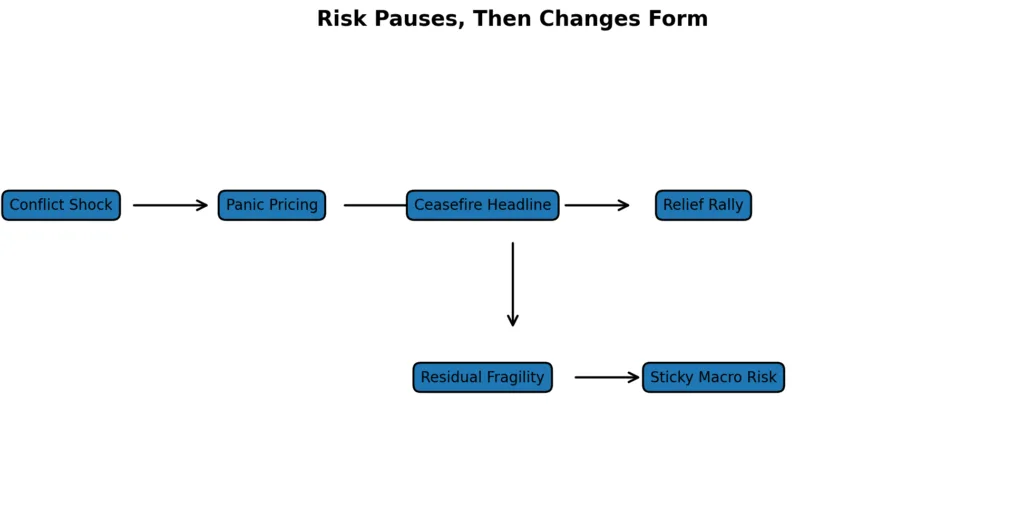
Market spreads have increased beyond their original levels which existed before the conflict began. Commodities maintain their geopolitical value because of ongoing conflicts. Investors continue to buy safe-haven assets. Market volatility decreases according to its current state yet it still exists. The market shows all necessary information to its users. The market operates with caution at this point. The market sees the ceasefire as an interim stage which will eventually lead to complete peace.
The speed of calm vs. the persistence of risk
There is an asymmetry in how markets process crisis and recovery.Fear spreads instantly. Calm builds slowly.A single headline can trigger a global selloff.Confidence needs continuous proof to be restored. The process needs continuous evidence that shows actual security not temporary protective signs.
Market reactions to ceasefires happen more quickly than the subsequent economic recovery process. Prices change right away. Systems change at a slow pace. The market maintains hidden volatility during that period which exists throughout its entire structure.